
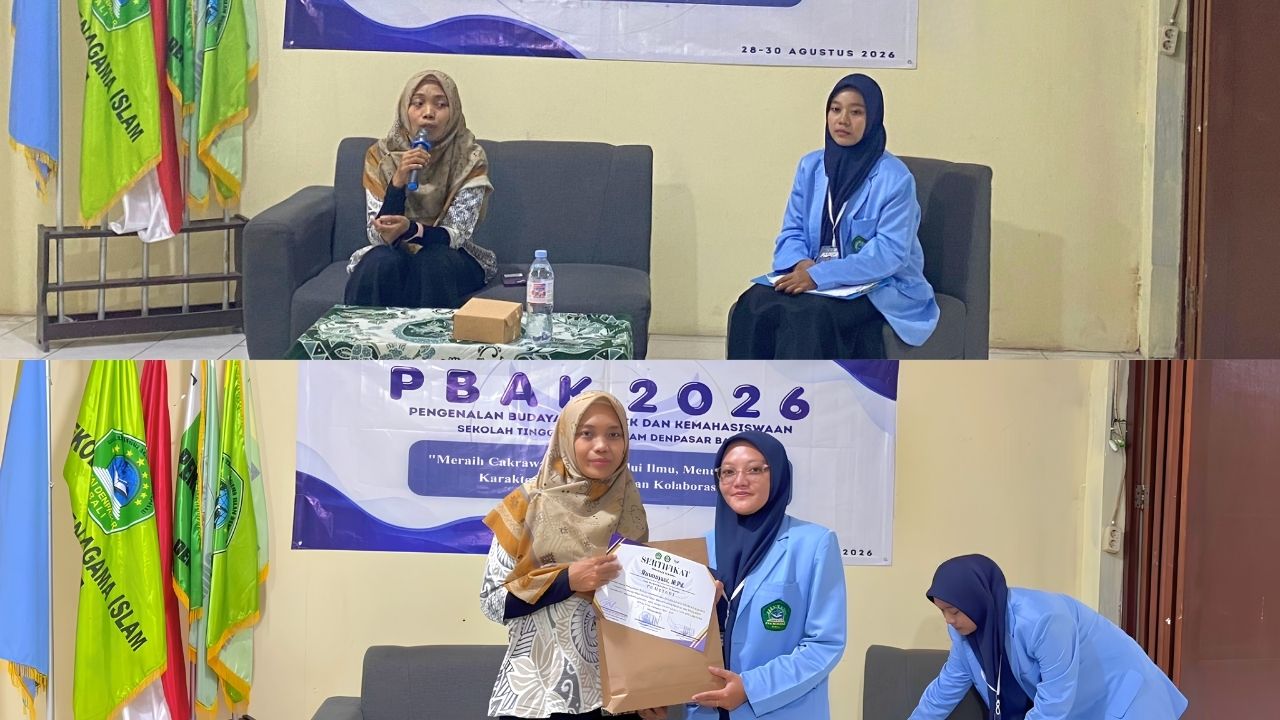
Denpasar – The 2026 New Student Collage Academic Culture Introduction Program (Pengenalan Budaya Akademik/PBAK) at STAI Denpasar Bali served as an important starting point for new students to gain a comprehensive understanding of university life. Through the Academic Orientation Session, Rusmayani, M.Pd., Vice Chair I for Academic Affairs and Curriculum at STAI Denpasar Bali, provided students with essential insights into the academic system, national identity, religious moderation, student life, and character development. The session was moderated by Najwa Surya Ram Dhiana.
The academic orientation was designed to help students understand the transition from secondary education to higher education, where learning patterns and responsibilities become significantly different. Beyond administrative matters, the session was intended to prepare students to navigate academic life independently, with discipline and responsibility, while remaining grounded in Islamic and national values.
Strengthening National Awareness and Religious Moderation
One of the key topics discussed during the session was national awareness and religious moderation. Understanding these two aspects is considered essential for students at Islamic higher education institutions so that intellectual development can go hand in hand with the ability to live responsibly and maturely within a diverse society.
In the context of national awareness, students were reintroduced to the four pillars of Indonesian national life: Pancasila, the 1945 Constitution of the Republic of Indonesia, the Unitary State of the Republic of Indonesia (NKRI), and Bhinneka Tunggal Ika. Understanding these values forms an important part of developing students’ awareness of national life, social responsibility, unity, and respect for diversity.
The discussion was then connected to the importance of religious moderation. Students are expected to develop an inclusive religious outlook, respect differences, practice tolerance, and apply religious values in social life in a balanced and peaceful manner.
In the context of Bali, which is characterized by rich social and cultural diversity, these values are particularly important in helping students build respectful interactions with others. Students are not only prepared to develop academic competence but are also encouraged to understand their responsibilities as members of a pluralistic society.
Getting to Know STAI Denpasar Bali as an Academic Home
The orientation also encouraged new students to become familiar with STAI Denpasar Bali as both an academic institution and a space for personal development. Understanding the institution’s identity helps students recognize the environment in which they will study, grow, and prepare for their future professional careers.
As part of the institutional introduction, students were guided to understand the institution’s profile, vision and mission, as well as the expected qualities and characteristics of its graduates. This knowledge is important in giving students a clear picture of the direction and objectives of their education.
Students were also introduced to the campus organizational structure, including the Chair of STAI, Vice Chairs, heads of study programs, administrative staff, and lecturers. Understanding this structure enables students to identify the various elements supporting the educational process, as well as the appropriate channels for academic and administrative services.
In terms of facilities, students were introduced to various learning resources, including classrooms, the library, the language laboratory, and the computer laboratory. These facilities are an essential part of the learning environment and are expected to be used responsibly to support students’ academic development.
Adapting to Academic Systems and Culture
Entering higher education means entering a learning environment that differs significantly from school. Students are expected to take greater responsibility for managing their studies, understand their academic obligations, and play a more active role in the learning process.
One of the important services introduced during the session was the Academic Information System (SIAKAD), accessible through siakad.staidenpasar.ac.id. Students were encouraged to understand the role of SIAKAD in supporting various academic needs, including the completion of the Study Plan Card (KRS), checking academic results and grades, and accessing academic information and calendars.
In addition to academic administration, students were introduced to the Three Pillars of Higher Education (Tri Dharma Perguruan Tinggi): education and teaching, research, and community service. This concept emphasizes that university life extends beyond attending lectures and includes the development of knowledge as well as meaningful contributions to society.
Throughout their studies, students also need to understand the Semester Credit System (SKS), Grade Point Average (IP), Cumulative Grade Point Average (IPK), academic evaluation, graduation requirements, and attendance regulations. Familiarity with these aspects enables students to manage their academic journey in a more structured and responsible manner.
Understanding Study Programs and Competency Development
The academic orientation also plays an important role in helping students understand the academic fields they have chosen. The curriculum, academic focus, learning objectives, and competency development pathways are essential elements that students need to understand from the beginning so that they can pursue their education more effectively.
STAI Denpasar Bali offers a number of undergraduate and graduate programs. At the undergraduate level (S1), these include Islamic Religious Education (PAI) and Islamic Education Management (MPI) under the Faculty of Tarbiyah and Teacher Training, Sharia Economics (ES) under the Faculty of Islamic Economics and Business/Faculty of Sharia, and Islamic Communication and Broadcasting (KPI) under the Faculty of Da’wah and Communication. At the graduate level (S2), the institution offers a Master’s Program in Islamic Religious Education (PAI).
Understanding the characteristics and academic focus of each study program is expected to help students identify the field of knowledge they are pursuing and develop their competencies in a more focused and purposeful manner throughout their studies.
Student Life as a Space for Personal Development
Higher education also provides students with opportunities to learn through organizational experiences and extracurricular activities. Such activities can help develop leadership, communication, teamwork, creativity, organizational skills, and social responsibility.
Within the structure of Student Organizations (Ormawa), students were introduced to the Student Executive Council (DEMA), Student Senate (SEMA), and Student Association of each Study Program (HMPS). These organizations provide opportunities for students to participate actively, collaborate with others, express their aspirations, and develop leadership skills.
Meanwhile, Student Activity Units (UKM) provide opportunities for students to develop their interests and talents. Areas of development include religious activities, sports, arts, as well as academic and intellectual pursuits. Participation in student activities is expected to remain balanced with academic responsibilities.
Students were also reminded of the importance of understanding the campus code of ethics and regulations. Their attitude, appearance, behavior, and communication with fellow members of the campus community should reflect respect and responsibility. Maintaining a safe, respectful, and dignified educational environment also requires a shared commitment to preventing bullying, intimidation, sexual violence, and other inappropriate behavior.
Building Effective Study Habits and Good Character
The transition from school-based learning to university-level education requires mental preparation and the development of new habits. Students need to cultivate a culture of independent learning, active participation in lectures, reading, note-taking, preparation, time management, and consistent completion of academic responsibilities.
Communication etiquette with lecturers is also an important part of academic culture. Whether communicating directly or through messaging applications, students are expected to consider politeness, clarity, appropriate communication hours, and respect for lecturers as educators.
Within the context of Islamic higher education, academic ability also needs to be developed alongside akhlakul karimah, or noble character. Integrity, discipline, responsibility, respect for others, and adherence to academic ethics are essential foundations for developing students who are not only intellectually capable but also demonstrate strong moral character.
Preparing Students for Higher Education
The Academic Orientation Session as part of the 2026 PBAK program for new students at STAI Denpasar Bali ultimately provided a strong foundation for understanding university life in a comprehensive manner. Academic systems, institutional structures, student organizations, campus ethics, study strategies, national awareness, and religious moderation are interconnected elements in the adaptation process of new students.
Through this orientation, students are expected to begin their higher education journey with academic readiness, independence, integrity, leadership potential, and social awareness. At the same time, values of religious moderation, national commitment, and akhlakul karimah are expected to become integral parts of the character of STAI Denpasar Bali students as they pursue their academic journey and make positive contributions to society.
The event concluded with the presentation of a souvenir and a closing statement delivered by Nadia Rizky Amelia Safitri, President of the Student Executive Council (PRESMA) of DEMA STAI Denpasar Bali.