
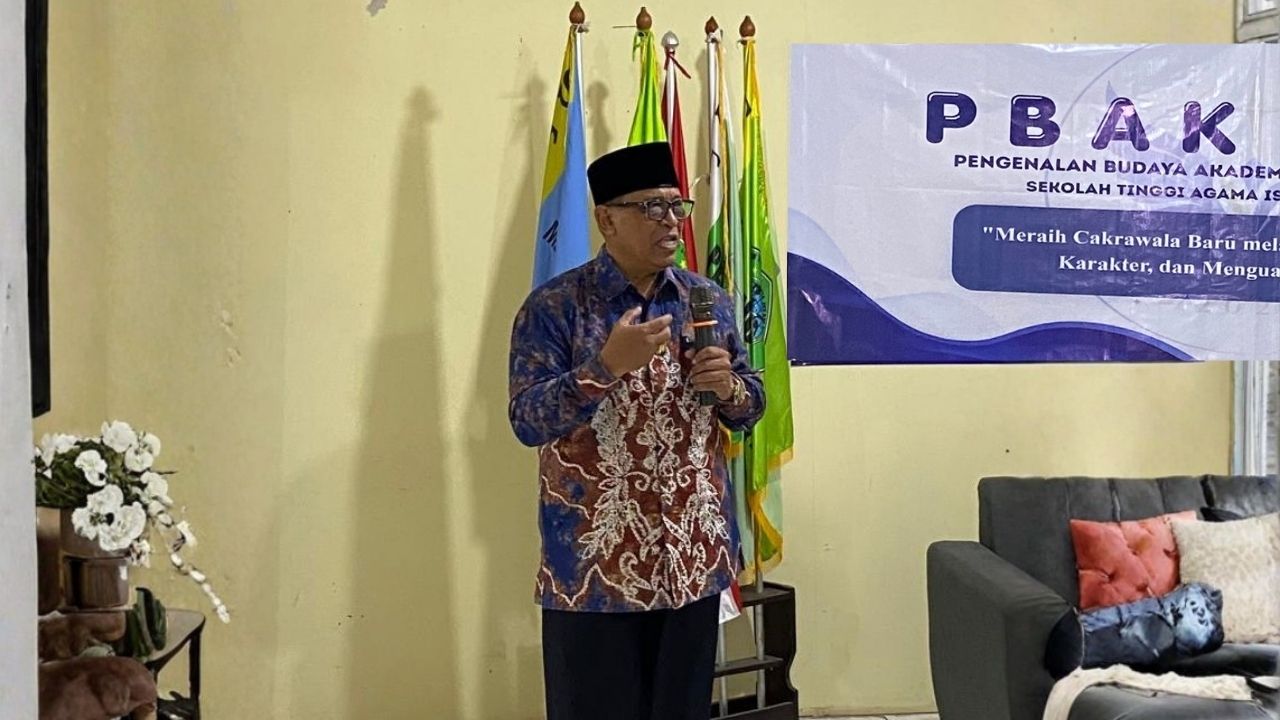
STAI Denpasar Bali — Beginning higher education means entering more than a new place of learning. It also means becoming part of a social and academic community with its own people, cultures, habits, organizations, traditions, and patterns of interaction. This perspective was highlighted during the Campus Anthropology (Antropologi Kampus) session as part of the Pengenalan Budaya Akademik (PBAK) for New Students 2026 at STAI Denpasar Bali.
The session was delivered by Dr. H. Arjiman, M.Pd., Chairman of STAI Denpasar Bali, who introduced new students to campus life from a broader social and cultural perspective. The discussion encouraged students to understand campus not simply as a place where lectures take place, but as a living academic environment in which intellectual, organizational, professional, and interpersonal relationships develop continuously.
Through this perspective, new students were encouraged to become more aware of how campus communities function and how their own attitudes and participation can contribute to a healthy academic environment.
Understanding the Campus as a Community
One of the central points of the Campus Anthropology session was the recognition that a higher-education institution consists of diverse groups whose roles are interconnected.
The campus community includes institutional administration and bureaucracy, educators or lecturers, students, and the wider community surrounding the institution. Each component has different responsibilities and functions, but none operates completely independently.
Administrative personnel support institutional and academic services, lecturers carry out educational and scholarly responsibilities, students participate as learners and members of the academic community, while the surrounding community forms part of the broader social environment in which the institution exists.
Understanding these relationships is important for new students because successful academic life depends not only on individual achievement but also on communication, mutual respect, responsibility, and constructive interaction among members of the campus community.
For students, learning how to communicate appropriately with lecturers and staff, work with peers, understand institutional procedures, and engage respectfully with the wider community becomes part of the learning process itself.
Recognizing Diversity Among Students
The session also explored different patterns of student life and participation. These typologies were presented as illustrative social patterns rather than rigid classifications or judgments of individual students.
Among the patterns discussed were academic-oriented students, described through the familiar Indonesian expression “Kupu-Kupu” (Kuliah-Pulang); activist-oriented students or “Kura-Kura” (Kuliah-Rapat); students who devote significant time to social activities or leisure, referred to as “Kunang-Kunang” (Kuliah-Nangkring); and religiously oriented students, or “Kuda-Kuda” (Kuliah-Dakwah).
The discussion also recognized students who may demonstrate apathetic tendencies, students with strong social orientations, and working students, described as “Kuman.”
Rather than encouraging students to identify themselves through a single label, the discussion illustrated the diversity of experiences and priorities that exist within a student population. Students may simultaneously balance academic responsibilities, organizational activities, religious engagement, social relationships, employment, and personal development.
This diversity can become a strength when accompanied by self-awareness and the ability to maintain a healthy balance. For new students, the challenge is to identify priorities, manage time responsibly, and ensure that social or organizational involvement complements rather than undermines their academic development.
Learning the Informal Culture of Campus
Every higher-education institution develops a distinctive local culture. Beyond formal rules and academic regulations, students encounter informal habits, expressions, traditions, social spaces, and patterns of interaction that shape everyday campus life.
The Campus Anthropology session introduced students to several aspects of this informal culture, including language, campus jargon and slang, social spaces, traditions, seniority structures, student gathering places or “basecamps,” and patterns of peer interaction.
The discussion also touched on familiar student habits such as “SKS” (Sistem Kebut Semalam), or intensive last-minute studying, and cycles of staying up late to complete academic tasks.
At the same time, campus culture can include spaces for open discussion, free expression, and critical engagement. Such spaces can contribute positively to intellectual development when freedom of expression is accompanied by responsibility, respect, evidence-based reasoning, and ethical boundaries.
For new students, understanding these informal dimensions of campus life can make adaptation easier. Awareness, however, should not mean simply following every existing habit. Students are expected to evaluate campus practices critically and maintain academic discipline, professionalism, mutual respect, and responsible conduct.
Campus Organizations as a Learning Environment
Campus life also provides opportunities for students to learn through organizational participation. In this context, the Campus Anthropology session presented the university environment as a small-scale social and political learning space.
Student organizations can provide practical experience in leadership, representation, teamwork, communication, networking, advocacy, negotiation, and collective decision-making.
Within student government structures, students may encounter executive institutions such as BEM and HIMA, legislative bodies such as DPM or SEMA, as well as judicial functions or structures where applicable.
Students may also participate in intra-campus organizations and external student organizations, commonly known as OMEK. These organizations can provide additional spaces for intellectual development, social engagement, leadership formation, advocacy, and networking.
Such experiences demonstrate that learning does not take place exclusively inside classrooms. Organizational activities can also become practical laboratories in which students learn how to communicate ideas, work with people who have different perspectives, formulate collective positions, and assume responsibility for decisions.
Understanding Student Politics Constructively
Another aspect of campus organizational life is student politics. Through student elections or Pemira, students may encounter coalitions, campaigns, public debates or public testing, negotiation, lobbying, and advocacy with campus administration.
Presented appropriately, these processes can become valuable democratic learning experiences. Students can learn about representation, leadership, political communication, negotiation, collective interests, and responsible participation.
Campus politics should therefore not automatically be viewed as something negative. When conducted ethically and responsibly, it can help students understand how decisions are made, how different interests interact, and how constructive advocacy can be carried out.
For students, the important lesson is not simply how to win an organizational contest, but how to participate in collective processes while maintaining integrity, respect, accountability, and concern for the wider academic community.
Why Campus Anthropology Matters
Understanding campus anthropology offers practical benefits for students beginning their higher-education journey.
First, it provides a form of academic and social survival strategy. Awareness of campus culture can help students recognize expectations, establish appropriate relationships, adapt to unfamiliar situations, and navigate the academic environment more wisely.
Second, campus becomes a space for discovering identity. Through academic study, organizations, social interaction, religious activities, and other experiences, students can explore their interests, values, abilities, aspirations, and leadership potential.
Third, understanding social dynamics can strengthen conflict-resolution and negotiation skills. Differences of opinion are a natural part of community life. Students who can listen, communicate clearly, understand different perspectives, and seek constructive solutions are better prepared to manage disagreement.
Fourth, social awareness can help students avoid unhealthy social traps, including excessive peer pressure, misinformation, exclusion, unproductive environments, or patterns of behavior that interfere with academic responsibilities.
Finally, campus organizational experiences can provide a practical simulation of professional organizational life. The ability to communicate, collaborate, negotiate, lead, build networks, make decisions, and understand organizational dynamics can become valuable preparation for students’ future professional environments.
Beginning the Academic Journey with Greater Awareness
The Campus Anthropology session therefore positioned PBAK 2026 as more than a conventional introduction to campus facilities or academic procedures. It provided new students with an intellectual framework for understanding the campus as a complex social and cultural environment.
For STAI Denpasar Bali, introducing students to this broader understanding is part of preparing them to become members of an academic community who are intellectually capable, ethically grounded, socially responsible, and able to participate constructively in institutional life.
The session also reinforced the idea that higher education is a multidimensional process. Students learn through lectures and academic assignments, but they also learn through relationships, organizations, dialogue, leadership, negotiation, community engagement, and everyday experiences.
As the 2026 new students begin their journey at STAI Denpasar Bali, understanding the anthropology of campus can become an important foundation for navigating their new environment with greater maturity and awareness. More importantly, it can encourage them to become active participants rather than passive observers of academic life.
PBAK 2026 thus marks an early chapter in a longer journey of intellectual growth and personal development—one in which students are expected not only to acquire knowledge, but also to learn how to think critically, interact responsibly, organize constructively, adapt wisely, and contribute meaningfully to the academic community and society.