
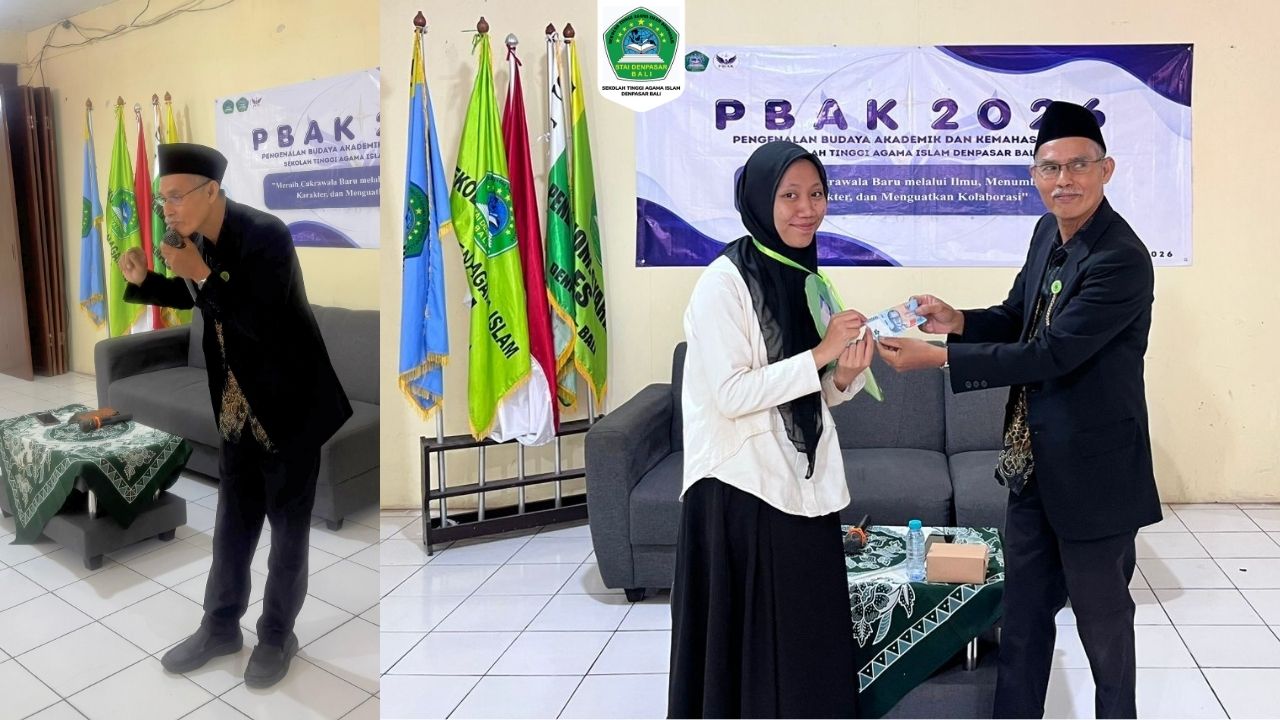
STAI Denpasar Bali – Conducted an academic orientation session introducing new students to the Islamic Communication and Broadcasting Study Program (Komunikasi dan Penyiaran Islam/KPI). The session was designed to provide students with an initial understanding of the academic environment they are entering and the competencies they are expected to develop throughout their university education.
The session was delivered by Mohammad Hisyam, M.Pd.I., Permanent Lecturer at STAI Denpasar Bali. Through the orientation, new students were introduced to the educational direction of the KPI Study Program, the integration of communication studies and Islamic values, the academic learning system, practical and project-based experiences, professional competencies, and potential career pathways.
For new students, the introduction to their study program represents an important starting point in understanding the expectations and responsibilities associated with higher education. The transition into university life requires students not only to attend lectures and complete academic requirements but also to develop a clear understanding of their field of study and its relevance to wider social and professional contexts.
The session introduced students to the broader academic direction of the Islamic Communication and Broadcasting Study Program, which brings together contemporary communication knowledge and Islamic values. Within this framework, students are encouraged to develop an understanding of communication as an academic discipline while also recognizing the ethical and social responsibilities associated with conveying information and engaging with society.
Areas such as journalism, broadcasting, public relations, public communication, and digital media provide important contexts for the development of communication competencies. At the same time, Islamic perspectives on communication and da’wah, or Islamic outreach, provide an ethical foundation for students in understanding how messages can be communicated responsibly, constructively, and with respect for human dignity.
The discussion also introduced potential professional directions that may be pursued in accordance with students’ competencies, interests, experiences, and future career development. These potential pathways may include work in broadcasting through radio, television, or other media platforms; journalism and news production; public relations and institutional communication; digital content development; professional Islamic communication and da’wah; as well as other communication-related fields.
These pathways were presented as possible directions rather than guaranteed employment outcomes. Students were encouraged to understand that professional readiness requires continuous learning, the development of relevant competencies, practical experience, adaptability, and the ability to respond to developments within the communication and media environment.
An important part of the orientation concerned the academic structure and areas of study that may support the development of students’ professional communication abilities. The discussion provided an overview of subjects and learning areas related to print and electronic journalism, da’wah rhetoric, public speaking, cinematography, photography, communication psychology, and broadcast production.
These areas of study can help students develop a combination of conceptual understanding and practical communication skills. Journalism may introduce students to the principles of information gathering, writing, verification, and responsible publication, while broadcasting and media production can provide a foundation for understanding how messages are developed and delivered through different communication platforms.
Public speaking and da’wah rhetoric are also relevant to the development of effective verbal communication. Photography and cinematography, meanwhile, introduce visual dimensions of communication and storytelling. Communication psychology can help students understand the relationship between messages, audiences, perceptions, and human interaction.
The academic orientation also emphasized the importance of Islamic and institutional perspectives within communication education. Students may encounter academic discussions related to Qur’anic and Hadith-based perspectives on communication, as well as the history and development of da’wah. These foundations are intended to help students connect professional communication competencies with ethical awareness and Islamic values.
In addition to introducing academic subjects, the session provided students with an initial understanding of the university learning system. The Semester Credit System (Sistem Kredit Semester/SKS) and the Study Plan Card (Kartu Rencana Studi/KRS) form important components of academic planning and progression.
Students were encouraged to understand academic procedures from the beginning of their university journey and to approach study planning responsibly. Academic consultation and guidance with an Academic Advisor (Dosen Pembimbing Akademik/DPA) can also play an important role in helping students understand their study load, plan their academic progression, and respond appropriately to academic requirements.
The orientation further highlighted the practical and competency-oriented nature of communication studies. Communication education involves more than theoretical discussion, as students may also encounter project-based and output-oriented learning experiences that connect academic knowledge with real communication practices.
Depending on the curriculum and applicable academic provisions, students may develop communication projects such as news content, podcasts, short films or documentary productions, da’wah media programs, communication campaigns, bulletins, or other forms of media publication. Practical assignments can provide students with opportunities to apply theoretical knowledge, develop creativity, strengthen technical skills, and gain experience in collaborative work.
Such learning experiences also encourage students to understand the importance of responsibility in the communication process. Producing media content requires attention to accuracy, ethics, audience considerations, and the potential social impact of published information. Students are therefore expected to develop not only technical competence but also professional judgment in the use and production of communication materials.
The session also provided an introduction to facilities and academic resources that may support practical learning and competency development. Depending on institutional provisions and available resources, communication education may involve the use of broadcasting spaces, communication laboratories, production areas, editing facilities, libraries, and other academic resources.
Students may also receive guidance regarding procedures for borrowing and using institutional equipment, including cameras, tripods, lighting equipment, microphones, and other production tools where available and applicable. The responsible and ethical use of institutional facilities was emphasized as an important aspect of professional preparation. Learning to care for shared equipment and follow established procedures can contribute to a culture of responsibility within the academic community.
A particularly relevant dimension of the KPI Study Program at STAI Denpasar Bali is the importance of communication within a multicultural environment. Bali provides a diverse social and cultural context in which students can develop greater awareness of intercultural and interfaith communication.
Students of Islamic Communication and Broadcasting are encouraged to develop sensitivity toward cultural diversity and to understand that effective communication requires awareness of social context, audience differences, and local values. Islamic communication and da’wah can therefore be approached in constructive, peaceful, ethical, and respectful ways that contribute positively to society.
The discussion also highlighted the importance of appreciating local wisdom and values that support harmonious social relationships, including the principle of Menyama Braya, which is associated with the value of social harmony and a sense of mutual connection within Balinese society. Such cultural awareness can help students develop communication approaches that respect diversity while maintaining their own religious identity and ethical principles.
In the contemporary media environment, students also have an important responsibility to contribute to healthy and constructive communication. The development of communication content should be accompanied by awareness of the risks associated with misinformation, hate speech, intolerance, and divisive narratives. Students were encouraged to develop critical thinking and ethical judgment so that their communication practices can contribute to knowledge, understanding, and social harmony.
The orientation also introduced the broader value of student participation and organization. The Islamic Communication and Broadcasting Student Association (Himpunan Mahasiswa Program Studi/HMPS KPI) can serve as an important platform for student aspirations, collaboration, leadership development, and communication among members of the study program.
More broadly, student activities and initiatives related to journalism, photography, videography, public speaking, media production, and other communication competencies can provide opportunities for students to strengthen their soft skills and professional readiness. Participation in collaborative activities can support the development of leadership, teamwork, creativity, communication, problem-solving, and professional networking.
As students progress through their academic journey, professional exposure and practical experience may also become increasingly important. The session provided an early perspective on the potential value of internships and field-based learning experiences in relevant professional environments.
Depending on institutional cooperation, availability, academic requirements, and applicable regulations, students may have opportunities to gain practical exposure within broadcasting organizations, radio or television environments, print or online media, communication institutions, or public relations divisions. Such experiences can help students understand professional expectations and connect academic competencies with practical working environments.
The orientation also provided students with an early understanding of possible academic pathways toward the completion of their studies. In accordance with applicable academic regulations, students may eventually undertake communication research, academic writing, or other approved final academic projects. Where permitted under relevant provisions, communication-based or production-oriented academic work may also provide opportunities for students to demonstrate their knowledge and competencies through approved media products.
Within the broader educational mission of STAI Denpasar Bali, the introduction to the KPI Study Program reflects the importance of preparing students with more than theoretical knowledge. Higher education is expected to support the development of relevant competencies, communication skills, ethical awareness, practical experience, technological adaptability, and social responsibility.
The integration of academic communication studies with Islamic values provides an important foundation for students as they prepare to engage with increasingly dynamic media and communication environments. At the same time, students are expected to understand the importance of professionalism, accuracy, responsibility, and respect for cultural diversity.
For students studying within Bali’s multicultural environment, communication competence must also be accompanied by cultural sensitivity and the ability to engage constructively with diverse communities. This perspective is relevant not only to academic learning but also to the broader role of future communication professionals in contributing to mutual understanding and responsible public discourse.
The Introduction to the Islamic Communication and Broadcasting Study Program therefore provided new students with an important starting point for understanding their academic identity and future development. Through a clearer understanding of the learning process, communication competencies, practical opportunities, ethical responsibilities, and potential professional directions, students can begin preparing themselves for a purposeful academic journey.
As they continue their studies at STAI Denpasar Bali, new KPI students are expected to actively develop their knowledge and competencies, participate in academic and practical learning experiences, uphold Islamic and professional ethics, and strengthen their ability to communicate responsibly. The orientation serves as an initial foundation for students to prepare for future contributions in communication, media, broadcasting, public relations, digital content, da’wah, and other relevant professional fields.