
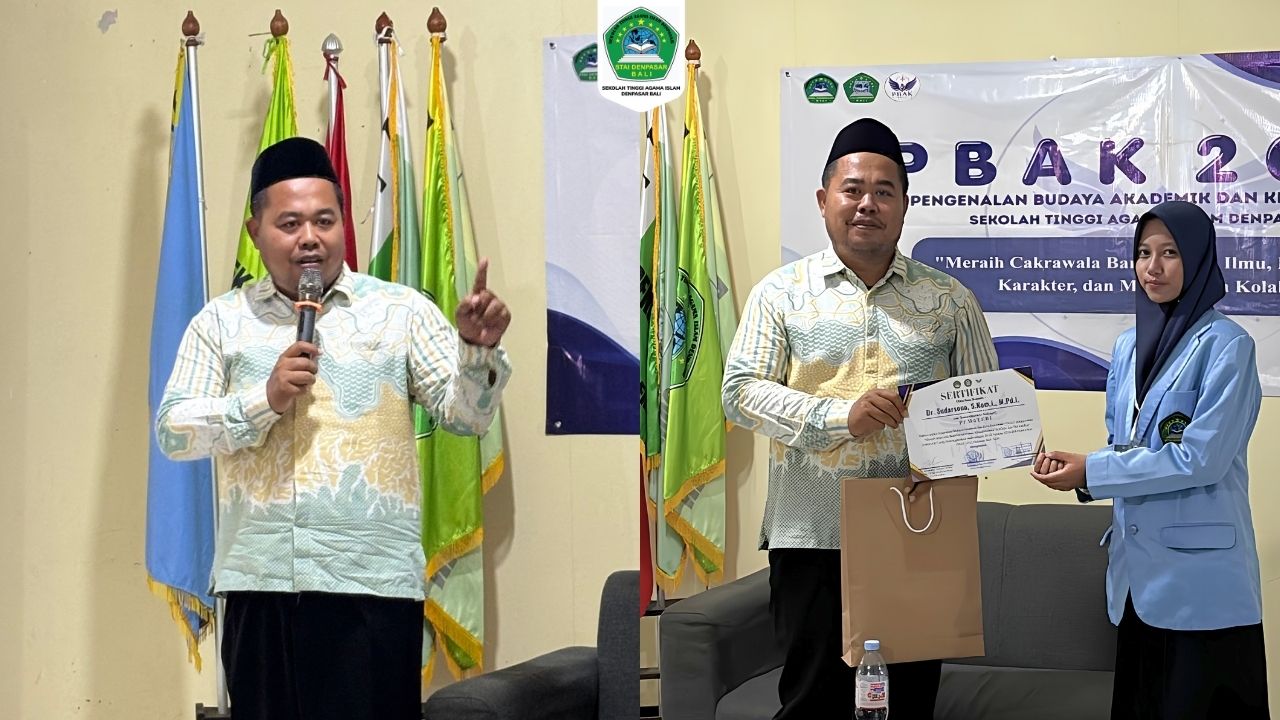
STAI Denpasar Bali – The Professional Development session encouraged new students to strengthen academic integrity, soft and hard skills, career readiness, digital literacy, entrepreneurship, and Islamic professionalism.
As part of the 2026 New Student Academic and Cultural Orientation Program (Pengenalan Budaya Akademik or PBAK), STAI Denpasar Bali conducted a Professional Development session designed to equip new students with essential competencies, attitudes, values, and professional readiness for their university journey. The session featured Dr. Sudarsono, S.Kom.I, M.Pd.I., Vice Chairperson III for Student Affairs, as the speaker, with Najwa Surya Ram Dhiana serving as moderator.
The session emphasized that entering higher education represents an important transition in students’ intellectual, personal, and social development. New students were encouraged to move beyond the learning habits of secondary education and develop a university mindset characterized by independence, initiative, critical thinking, discipline, and responsibility. University students are expected not only to pursue academic achievement but also to become proactive members of society who can contribute as agents of change, future human resources, and responsible participants in social development.
A central message of the session was the importance of integrating academic competence with akhlakul karimah, or noble character. Professional excellence, according to the discussion, should be accompanied by integrity, ethical conduct, responsibility, and Islamic work values. Students are therefore encouraged to develop intellectual abilities while maintaining honesty, respect, tolerance, and moral awareness. This principle is particularly relevant in Bali’s multicultural social environment, where students interact with people from diverse cultural, religious, and social backgrounds.
The development of a strong academic culture was also highlighted as an essential foundation for university life. Students were encouraged to uphold academic integrity through honest academic writing, responsible research practices, and a firm commitment to avoiding plagiarism. Punctuality, discipline, respectful communication, and constructive relationships with lecturers and academic staff were also presented as important elements of academic professionalism. These habits are expected to shape students’ character not only during their studies but also in their future professional environments.
Beyond academic knowledge, the session underscored the importance of developing both soft skills and hard skills. Leadership, teamwork, communication, public speaking, adaptability, and problem-solving were identified as important competencies for students preparing for professional life. At the same time, students were encouraged to strengthen discipline-specific expertise in accordance with their respective study programs, including Islamic Education Management, Islamic Religious Education, and Islamic Economics. The combination of academic expertise and interpersonal competence is expected to support students in responding effectively to professional and social challenges.
Student organizations were presented as valuable environments for putting these competencies into practice. Participation in organizations such as DEMA (Student Executive Council), SEMA (Student Senate), UKM (Student Activity Units), and HMPS (Study Program Student Associations) can provide practical opportunities for students to develop leadership, teamwork, communication, networking, conflict management, and organizational skills. Such experiences can serve as professional laboratories in which students learn how to make decisions, manage responsibilities, work with others, and respond to real organizational situations.
The session also encouraged students to begin career planning from the early stages of university education. Rather than waiting until graduation, students were encouraged to establish academic and professional targets for each semester. Maintaining a strong Grade Point Average (GPA) remains important, but students should also build a broader portfolio through committees, volunteering, internships, certifications, workshops, training programs, and other relevant experiences. A balanced combination of academic achievement and practical experience can strengthen students’ preparedness for further study and professional opportunities.
In an increasingly digital academic environment, digital literacy and research adaptation were also identified as essential competencies. Students need to develop the ability to use academic journals, digital research resources, learning platforms, and other technological tools ethically, critically, and productively. Digital technology should support academic research, coursework, knowledge development, and responsible participation in the wider digital environment rather than becoming a source of unverified information or academic misconduct.
The discussion further addressed entrepreneurship and edupreneurship as pathways toward greater independence. Students were encouraged to cultivate creativity, innovation, and entrepreneurial initiatives that can generate value and potentially contribute to job creation. Entrepreneurship, however, should remain grounded in ethical principles and Islamic values, including adherence to relevant Sharia principles. Through this approach, students can be encouraged to become not only prepared job seekers but also future innovators and creators of meaningful economic opportunities.
The broader role of students in higher education was also connected to the Tri Dharma of Higher Education, consisting of education and teaching, research, and community service. Students were encouraged to recognize that university life extends beyond attending lectures and completing assignments. Involvement in research projects, academic activities, and community service can provide valuable experiences while strengthening students’ professional portfolios, social awareness, research capabilities, and sense of responsibility toward society.
Effective time management and priority setting were presented as practical skills that students need to develop from the beginning of their academic journey. Balancing lectures, assignments, organizational activities, professional development, and personal responsibilities requires discipline and consistency. The ability to determine priorities and manage commitments effectively is expected to help students establish a professional work ethic that will remain relevant well beyond graduation.
Equally important, students were encouraged to develop emotional intelligence and resilience. University life may involve academic pressure, demanding assignments, revisions, interpersonal challenges, and unexpected setbacks. Self-awareness, emotional stability, adaptability, and the ability to recover from difficulties are therefore essential components of personal and professional development. Resilience can help students respond constructively to challenges while maintaining focus on their academic and long-term goals.
The session also highlighted the value of foreign language proficiency and competency development, particularly English and Arabic. Students were encouraged to prepare for their Diploma Supplement or Surat Keterangan Pendamping Ijazah (SKPI) by participating in professional certification, information technology training, workshops, and other competency-building activities. Foreign language abilities can provide additional academic and professional advantages, especially within Bali’s internationally connected environment and its position as a globally recognized tourism destination.
Another important aspect of professional preparation is the development of professional networking and mentorship. Students were encouraged to establish constructive relationships with lecturers, academic staff, alumni, professionals, and community leaders. Such relationships can broaden perspectives, provide guidance, introduce students to professional opportunities, and support informed academic and career planning. Networking, when developed ethically and professionally, can become an important component of long-term personal and professional growth.
Finally, the session addressed social media ethics and professional digital identity. Students were reminded that online activities create digital footprints that may affect their academic opportunities, professional relationships, and future careers. Responsible social media behavior therefore requires careful consideration of personal reputation as well as the reputation and positive image of the institution. Students were encouraged to communicate responsibly, protect their digital identity, and use social media as a constructive platform for knowledge sharing and positive engagement.
Within the broader educational context of STAI Denpasar Bali, the Professional Development session reflects the importance of preparing students to become academically capable, professionally competent, morally responsible, technologically adaptable, and socially engaged members of society. The integration of Islamic values with professional development is particularly significant in fostering graduates who are able to navigate contemporary challenges while maintaining ethical principles and respect for diversity.
Professional development is not a one-time process but a continuous journey that develops throughout a student’s academic and professional life. Through the knowledge and perspectives gained from the 2026 PBAK Professional Development session, new students of STAI Denpasar Bali are expected to build a strong foundation for becoming proactive, ethical, competent, resilient, innovative, and socially responsible future professionals and leaders.