
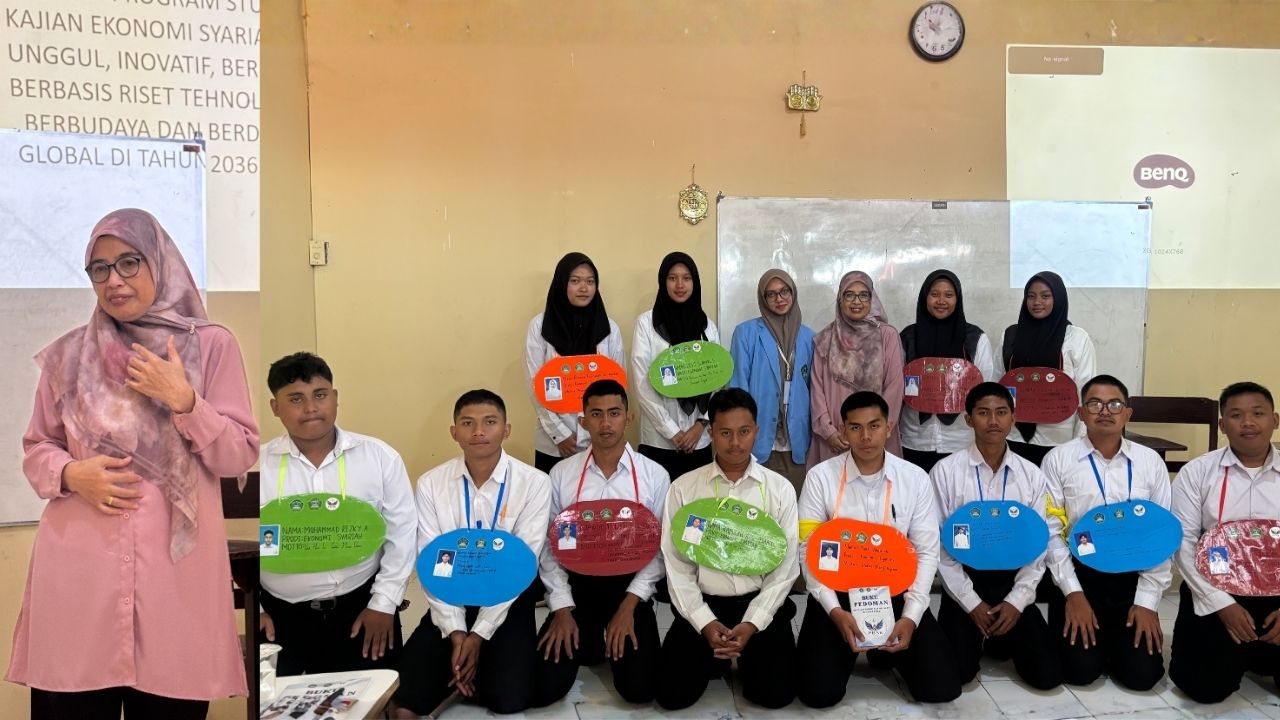
STAI Denpasar Bali – As part of the 2026 New Student Academic and Cultural Orientation Program, known in Indonesian as Pengenalan Budaya Akademik (PBAK), STAI Denpasar Bali organized an academic orientation session introducing new students to the Bachelor’s Program in Sharia Economics. The session was delivered by Hj. Kusjuniati, S.E., M.M., Head of the Sharia Economics Study Program, and was designed to provide students with an initial understanding of the academic identity, educational direction, and professional development opportunities that may shape their journey throughout their undergraduate studies.
The orientation served as an important starting point for new students as they entered a field of study that integrates economics, business, finance, accounting, and management with Islamic ethical principles. Beyond introducing the academic structure of the program, the session emphasized the importance of understanding Sharia Economics as a discipline that connects analytical knowledge with responsibility, fairness, ethical conduct, and social benefit.
Students were introduced to the broader direction of the Sharia Economics Study Program and to the relationship between contemporary economic activities and the principles that guide Sharia-based transactions. The discussion highlighted the importance of understanding economic and business activities through ethical perspectives, including awareness of principles related to the avoidance of prohibited elements such as riba, gharar, and maysir. In this context, the study of Sharia Economics was presented not only as an academic pursuit but also as a process of developing responsible approaches to financial and business decision-making.
Hj. Kusjuniati provided an overview of the potential professional directions that students may pursue as they develop their competencies and qualifications. These may include opportunities in Sharia banking and financial services, Sharia microfinance institutions, cooperatives, accounting and financial administration, financial analysis, Sharia compliance, ZISWAF management—including zakat, infaq, sadaqah, and waqf—halal business development, entrepreneurship, sociopreneurship, and other relevant areas of economic and business activity. The discussion emphasized that these pathways represent potential directions that depend on individual competence, professional qualifications, available opportunities, and applicable requirements.
The session also introduced students to the academic structure that will guide their learning throughout the program. Relevant areas of study may include Introduction to Islamic Economics, Fiqh Muamalah, Sharia Accounting, Management of Sharia Financial Institutions, Sharia Marketing, Islamic Business Ethics, and other areas related to economics, finance, business, and management. Together, these fields are intended to support students in understanding economic systems, financial management, business practices, and ethical decision-making from perspectives informed by Sharia principles.
An important part of the orientation was the introduction to academic procedures and responsible study planning. Students received an initial understanding of the Semester Credit System, or Sistem Kredit Semester (SKS), and the Study Plan Card, known as Kartu Rencana Studi (KRS). These academic instruments play an important role in organizing students’ learning plans and monitoring their academic progression. The session also highlighted the value of academic consultation and guidance through Academic Advisors, or Dosen Pembimbing Akademik (DPA), as students navigate their studies and make informed decisions regarding their academic development.
In addition to theoretical learning, the orientation underscored the importance of practical experiences in strengthening students’ understanding of economic and financial activities. Depending on academic provisions and available learning resources, practical education may involve simulations, computer-based learning, laboratories, and other supporting academic environments related to finance, banking, accounting, business, or investment. Such experiences can help students connect conceptual knowledge with practical processes and develop competencies relevant to professional environments.
The discussion also introduced the importance of financial literacy within the context of Sharia principles. Students may encounter educational discussions concerning Sharia-compliant financial instruments and economic practices as part of their broader academic development. The session emphasized the importance of understanding financial activities critically and responsibly, while recognizing the ethical principles that distinguish Sharia-based economic perspectives.
The relevance of Sharia Economics within Bali’s diverse economic and multicultural environment also formed an important part of the broader discussion. Bali provides a social and economic context in which students are encouraged to understand the importance of professionalism, cooperation, tolerance, and constructive engagement across diverse communities. Knowledge of Sharia Economics may be relevant to the development of halal-oriented businesses, tourism, hospitality, culinary enterprises, entrepreneurship, and other economic activities that interact with domestic and international communities.
Within this environment, students were encouraged to understand that economic development should be accompanied by respect for local communities and social diversity. Sharia-based economic knowledge can contribute to constructive participation in society when supported by professional competence, ethical awareness, communication skills, and a willingness to collaborate responsibly. The session therefore connected academic learning with the broader importance of social harmony and responsible engagement in a multicultural society.
As Head of the Sharia Economics Study Program, Hj. Kusjuniati also introduced students to the importance of understanding the academic environment and the people who support their learning journey. New students may interact with lecturers and academic personnel possessing expertise across areas related to Islamic economics, finance, banking, accounting, business, management, and other relevant disciplines. This academic environment is expected to support students as they gradually develop their knowledge, analytical abilities, and professional competencies.
Student development beyond the classroom was another important dimension of the orientation. The Sharia Economics Student Association, or Himpunan Mahasiswa Program Studi (HMPS), was presented within the broader context of student participation, aspirations, collaboration, leadership, and soft skill development. Student organizations and constructive initiatives can provide opportunities for learners to engage in academic discussions, business and entrepreneurship activities, seminars, financial literacy programs, research, competitions, and other activities that support personal and professional growth.
The session also highlighted the value of networking and broader academic engagement. Students may explore opportunities to participate in relevant communities, discussions, competitions, and academic initiatives as they progress through their studies. Such experiences can complement classroom learning by strengthening communication, leadership, teamwork, creativity, and professional awareness.
Professional exposure through internships, field experience, and other forms of practical learning may also become part of students’ academic development in accordance with applicable regulations and program requirements. Relevant professional environments may include Sharia financial institutions, banking and financial services, cooperatives, zakat and waqf institutions, halal-oriented businesses, financial administration offices, and other economic organizations. The orientation provided students with an early perspective on the importance of preparing themselves academically and professionally for opportunities that may arise during the later stages of their education.
Students were also introduced to the importance of preparing for academic research and final requirements. Future research may explore a wide range of topics, including financial management, business development, consumer behavior, Islamic finance, institutional management, halal industry development, and other economic issues viewed through relevant analytical and Sharia-based perspectives. The session emphasized the importance of building academic readiness from the beginning of the university journey through active learning, critical thinking, and continuous development.
Competency development beyond formal coursework was another area highlighted during the orientation. Students may strengthen their academic and professional profiles by participating in relevant training, workshops, professional development activities, and competency programs when available and appropriate. Areas such as Sharia banking fundamentals, Islamic philanthropy management, financial administration, accounting, digital business, and Sharia compliance awareness may contribute to broader competence and portfolio development.
The orientation further encouraged students to develop an entrepreneurial mindset. Sharia Economics students are not only expected to prepare themselves for potential employment opportunities but may also explore ways to create economic value through entrepreneurship and sociopreneurship. Opportunities for innovation may emerge in areas such as halal culinary enterprises, Muslim fashion, digital businesses, creative industries, and other responsible business initiatives. Meaningful entrepreneurship requires preparation, financial literacy, business planning, innovation, ethical awareness, and a commitment to sustainable value creation.
Students were also encouraged to remain open to scholarship opportunities, academic competitions, research activities, and other constructive programs that may support their development. Such opportunities may be available through government institutions, financial institutions, philanthropic organizations, educational partners, or other relevant providers, subject to eligibility requirements and program availability. Active participation in academic and professional development can help students broaden their experience and strengthen their readiness for future challenges.
Professionalism and business ethics were equally emphasized as important elements of student development. Academic competence should be accompanied by discipline, responsible communication, appropriate professional conduct, customer service awareness, presentation skills, and the ability to interact respectfully with lecturers, colleagues, staff, clients, and other stakeholders. Within the framework of Sharia Economics, professional development is closely connected with integrity, responsibility, fairness, and ethical conduct.
The discussion also provided a broader perspective on academic mobility and learning opportunities beyond the conventional classroom. Depending on applicable policies, institutional regulations, curriculum provisions, and program availability, students may have opportunities to engage in cross-disciplinary learning, collaborative research, internships, independent projects, entrepreneurship development, student creativity, and other recognized academic activities. Such experiences can support adaptability and encourage students to expand their knowledge through diverse forms of learning.
The introduction to the Bachelor’s Program in Sharia Economics therefore represented more than an initial explanation of courses and academic procedures. As part of the 2026 PBAK program, the session provided new students with a broader understanding of the responsibilities and opportunities that accompany their transition into higher education.
Through this orientation, STAI Denpasar Bali reaffirmed the importance of developing students who possess not only academic knowledge but also analytical ability, financial literacy, professional competence, ethical awareness, communication skills, technological adaptability, entrepreneurial capacity, and social responsibility. The integration of economic knowledge with Islamic ethical principles provides an important framework for understanding that economic development should consider not only growth and profitability but also fairness, responsibility, sustainability, and social benefit.
As they begin their academic journey, new students of the Sharia Economics Study Program are expected to use the knowledge introduced during the session as a foundation for continuous learning and development. By actively participating in academic activities, practical learning, organizational development, research, entrepreneurship, and other constructive opportunities, students can gradually strengthen the competencies and character needed for their future roles.
The orientation ultimately marked an important first step in helping students understand their academic identity and the broader possibilities within the field of Sharia Economics. Throughout their studies at STAI Denpasar Bali, students are expected to continue developing their knowledge, analytical abilities, professional skills, ethical awareness, and entrepreneurial mindset while remaining committed to responsible learning and constructive contributions to society.