
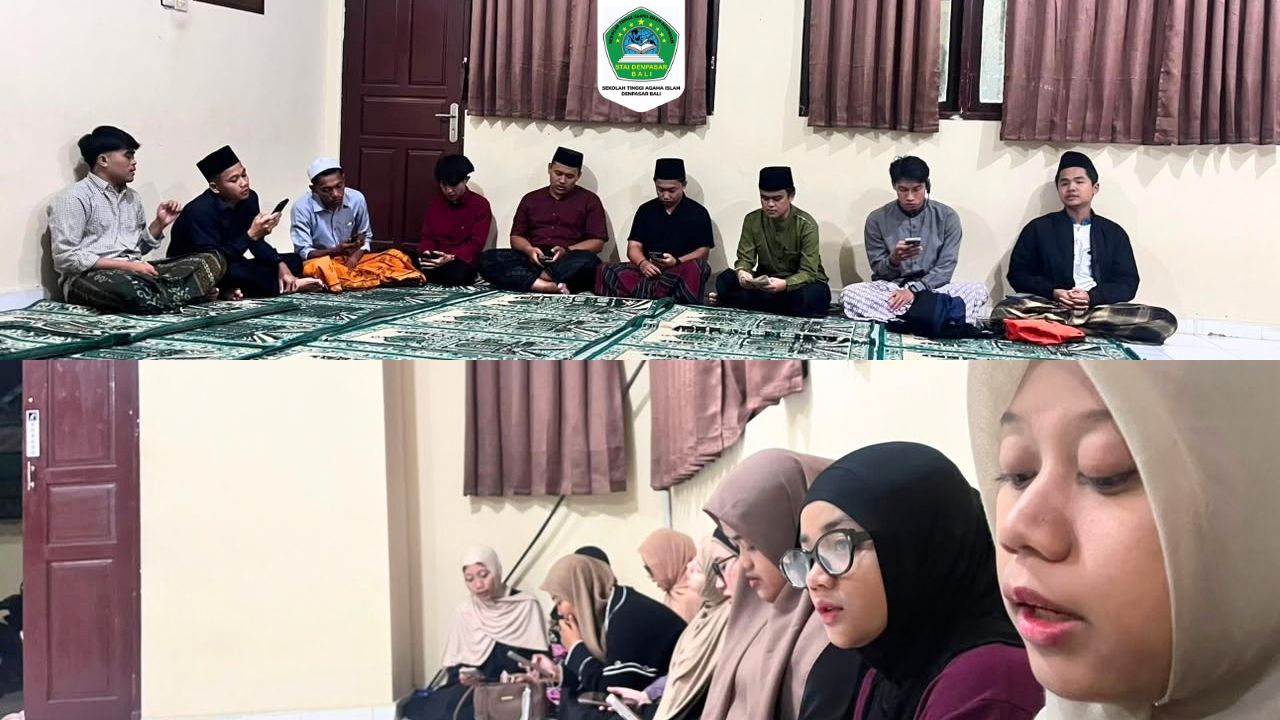
Denpasar, Bali — Students of Sekolah Tinggi Agama Islam (STAI) Denpasar Bali continue to strengthen their engagement with the Qur’an through a routine Qur’an Muroja’ah activity held at the institution’s Musholla. The activity serves as a regular space for students to maintain Qur’anic recitation, reinforce memorization, and cultivate spiritual discipline as part of their academic and personal development.
The routine Muroja’ah brings together students in a shared learning environment centered on the Qur’an. Rather than functioning merely as a ceremonial religious gathering, the activity provides an opportunity for students to build consistency in their interaction with the Qur’an while developing habits that support discipline, concentration, patience, and personal responsibility.
The Musholla at STAI Denpasar Bali provides an appropriate setting for this ongoing activity. As a place dedicated to worship and spiritual reflection, the Musholla also becomes a space where students can strengthen their relationship with the Qur’an collectively. Through regular participation, students are encouraged to make Qur’anic engagement part of their everyday lives rather than limiting it to particular occasions.
Strengthening Qur’anic Learning Through Muroja’ah
In the context of Qur’anic learning, muroja’ah refers to the repeated review of Qur’anic verses to maintain and strengthen memorization and recitation. Consistent repetition is an important part of maintaining familiarity with previously learned material and encouraging students to remain committed to their Qur’anic learning.
Routine Muroja’ah also requires students to develop consistency. Maintaining a regular practice requires commitment, time management, concentration, and willingness to continue learning. These qualities are closely connected with the broader educational process because students are expected not only to acquire knowledge but also to develop habits that support lifelong learning.
For students in an Islamic higher-education environment, Qur’anic learning can also provide an important foundation for spiritual awareness and ethical development. Regular engagement with the Qur’an encourages students to reflect on the values they encounter in their learning and to consider how those values can be incorporated into their daily conduct.
Building Discipline and Personal Responsibility
The routine nature of the activity is one of its important educational dimensions. Students are encouraged to participate consistently and take personal responsibility for maintaining their Qur’anic learning. Such a practice can help cultivate discipline through a simple but meaningful routine: reading, reviewing, listening, repeating, and continuing to improve.
The process also requires patience. Qur’anic memorization and recitation develop gradually, and students may encounter different levels of progress. A supportive collective environment can therefore encourage students to remain persistent while appreciating their own learning process.
Beyond individual development, the activity creates opportunities for positive peer interaction. Students can encourage one another and develop a stronger sense of solidarity through a shared commitment to Qur’anic learning. This collective dimension contributes to the development of a supportive academic community in which spiritual growth and educational development can take place alongside one another.
Participation of STAI Denpasar Bali Students
The routine activity involved both male and female students from the STAI Denpasar Bali academic community. A total of 20 students were recorded as participating, consisting of 9 male students and 11 female students.
The participating male students were Afrizal Amiruloh, A. Ziadatul Qiram, Rahman Alfani, Pajrul Rijal, Agus Dwi, Muhammad Khanan Abdillah, Samsung Nuril Khoironi, M. Andrean, and Habi Sutrisno.
The participating female students were Durrotun N, Khansa, Evi, Ismi, Nafis, Anisa, Fika, Iva, Tika, Devi, and Cinta.
The participation of students from different study programs also reflects the potential of Qur’anic activities to become a shared space for the wider academic community. Students can meet and engage in a common spiritual practice while maintaining their respective academic responsibilities.
Integrating Spiritual and Academic Development
The Routine Qur’an Muroja’ah is aligned with a broader understanding of higher education in which student development encompasses more than academic achievement. Knowledge, character, ethics, spirituality, discipline, and social responsibility are interconnected aspects of personal development.
For an Islamic higher-education institution such as STAI Denpasar Bali, maintaining opportunities for students to engage with the Qur’an provides an important complement to classroom-based learning. Academic development equips students with intellectual competencies, while spiritual and character development can help students reflect on how knowledge should be applied responsibly in their personal and social lives.
Regular Qur’anic engagement can therefore become part of a balanced educational experience. Through continued practice, students are encouraged to develop both intellectual capacity and spiritual awareness, supporting their growth as learners and members of society.
Sustaining a Culture of Qur’anic Learning
The continuation of routine Muroja’ah represents an effort to establish positive habits that can extend beyond the campus environment. When Qur’anic recitation and review become part of students’ regular routines, the practice has the potential to support their personal development throughout their academic journey.
The activity also reinforces the importance of creating a campus environment where students have opportunities to develop intellectually, spiritually, and socially. Through simple but consistent activities, the values of discipline, responsibility, solidarity, and commitment to learning can be strengthened within the academic community.
Moving forward, routine Qur’an Muroja’ah can continue to serve as a meaningful part of student life at STAI Denpasar Bali. Consistent interaction with the Qur’an provides students with an opportunity to strengthen their recitation and memorization while cultivating habits of discipline and reflection. More broadly, the activity contributes to an educational environment that seeks to develop students who are not only academically prepared but also grounded in Islamic values, responsible character, and a commitment to lifelong learning.