
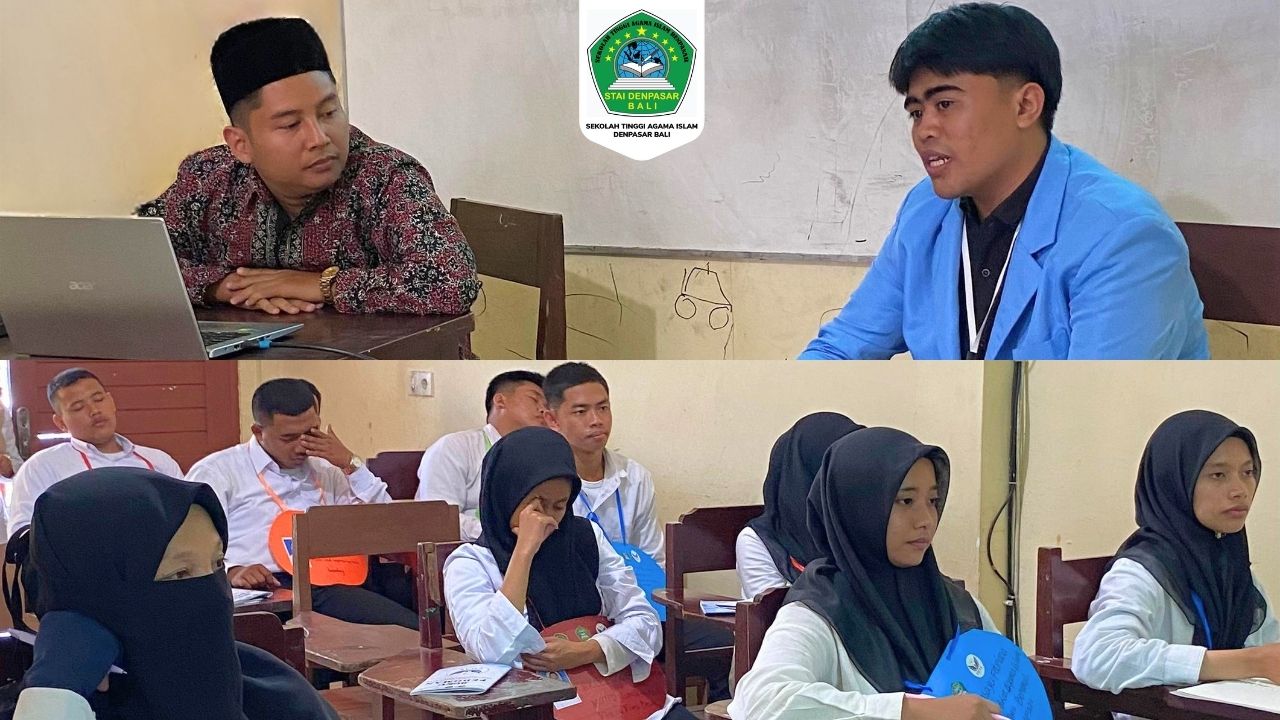
STAI Denpasar Bali – As part of the 2026 New Student Academic and Cultural Orientation Program (Pengenalan Budaya Akademik/PBAK), STAID organized an academic orientation session introducing new students to the Bachelor’s Program in Islamic Religious Education (Pendidikan Agama Islam/PAI). The session was delivered by Haris Nursyah Arifin, S.Si., M.Pd., Head of the Islamic Religious Education Study Program at STAI Denpasar Bali.
The session provided new students with an important starting point for understanding the academic environment they are entering and the educational journey that lies ahead. Beyond introducing the general structure of the study program, the orientation offered an overview of the knowledge, competencies, responsibilities, practical experiences, and ethical foundations associated with the field of Islamic Religious Education.
The introduction to the PAI Study Program emphasized the integration of Islamic scholarship and educational knowledge. Students were encouraged to understand that the study of Islamic Religious Education involves not only the development of religious knowledge but also the cultivation of pedagogical competence, professional awareness, communication skills, technological adaptability, and social responsibility.
Haris Nursyah Arifin highlighted the importance of developing a comprehensive academic foundation from the beginning of university study. Through the orientation, students gained an initial understanding of how Islamic knowledge and educational sciences can complement one another in preparing future professionals who are capable of contributing to educational institutions and wider society.
The discussion also introduced the academic direction of the study program and the potential professional pathways that may be pursued by graduates. These may include careers in Islamic Religious Education teaching, curriculum and learning development, Islamic education research, educational institution development, community-based educational activities, religious education programs, counseling-related activities, and other fields relevant to Islamic education.
These professional directions were presented as potential pathways that depend on individual competence, professional qualifications, available opportunities, and applicable regulations. The orientation therefore encouraged students to approach their university education as a process of continuous learning and competency development rather than viewing graduation as the sole objective of academic life.
New students were also introduced to the broad areas of learning that may form part of their academic development. The discussion covered the importance of integrating foundational Islamic knowledge with educational sciences, including areas related to Fiqh, Aqidah and Akhlak, the History of Islamic Civilization, Qur’anic Studies, Hadith Studies, Educational Psychology, learning strategies, educational evaluation, curriculum development, and Islamic education pedagogy.
These areas of study illustrate the interdisciplinary nature of Islamic Religious Education, in which a future educator is expected to understand both the substance of Islamic teachings and appropriate approaches to the teaching and learning process. The session emphasized that effective education requires students to develop knowledge, communication skills, analytical ability, and an understanding of learners and their educational needs.
Academic procedures were also introduced as an important part of the students’ transition into higher education. Participants received an overview of the Semester Credit System (SKS) and the Study Plan Card (Kartu Rencana Studi/KRS), which support the organization and planning of students’ academic journeys.
The orientation highlighted the importance of responsible study planning and encouraged students to seek academic guidance when necessary. Consultation with Academic Advisors (Dosen Pembimbing Akademik/DPA) was presented as an important element in helping students understand academic procedures, organize their studies, and make informed decisions throughout their university experience.
Practical learning was another significant aspect introduced during the session. As future educators, students may encounter teaching simulations, microteaching activities, lesson planning, learning module development, classroom communication, and other forms of competency-based preparation in accordance with the curriculum and applicable academic regulations.
Such experiences are important because they can help students connect theoretical understanding with educational practice. Through practical and reflective learning, students can begin to develop the confidence and professional awareness required to respond to real educational situations.
The session also provided an initial understanding of possible field experiences and professional exposure that may become part of students’ academic development. Internships, teaching practice, educational observation, and other forms of learning beyond the classroom may provide opportunities for students to understand professional environments, subject to academic regulations, institutional arrangements, cooperation agreements, and program availability.
Within the context of contemporary education, the discussion also emphasized the importance of digital literacy and educational innovation. Future educators increasingly need to understand how technology can support learning through digital platforms, interactive presentations, multimedia resources, educational videos, and other appropriate learning tools.
Students were encouraged to develop technological adaptability while maintaining ethical awareness and professional responsibility. The use of technology in education should support meaningful learning and should be approached responsibly, critically, and productively.
A significant aspect of the orientation was the relevance of Islamic Religious Education within Bali’s diverse and multicultural environment. Students were encouraged to recognize that professional competence must be accompanied by tolerance, constructive communication, social awareness, and respect for diversity.
As future educators and contributors to society, PAI students may play an important role in communicating Islamic values through educational approaches that are responsible, respectful, and responsive to their social environment. The discussion emphasized that a strong understanding of Islamic teachings can be accompanied by moderation, inclusivity, peaceful engagement, and respect for local wisdom and cultural diversity.
This perspective is particularly relevant within Bali’s multicultural setting, where interaction among communities requires sensitivity, mutual respect, and constructive communication. The orientation therefore positioned social awareness as an important part of students’ broader educational development.
The role of student organizations was also introduced as an opportunity for students to develop beyond formal classroom learning. The Islamic Religious Education Student Association (HMPS PAI) may serve as a platform for student aspirations, collaboration, leadership development, academic engagement, and personal growth.
Participation in student organizations and constructive student initiatives can provide opportunities to strengthen communication skills, teamwork, leadership, responsibility, creativity, and organizational experience. Activities related to academic discussion, public speaking, Islamic studies, educational engagement, community service, and other relevant initiatives may contribute to students’ broader development during their studies.
The session further emphasized the importance of community engagement and social responsibility. Students of Islamic Religious Education may be encouraged to contribute their knowledge and educational skills through constructive activities involving schools, community institutions, religious education initiatives, literacy programs, tutoring, volunteer work, or other relevant forms of service, in accordance with institutional policies and available opportunities.
Research and academic inquiry were also introduced as important components of higher education. New students received an early understanding of the potential role of research in examining issues related to Islamic learning processes, teaching strategies, learning media, curriculum development, educational innovation, student character development, educational psychology, religious literacy, and the evaluation of Islamic education.
Specific research procedures and final academic requirements, however, remain subject to the official academic regulations and research guidelines of STAI Denpasar Bali. The orientation encouraged students to gradually develop academic curiosity and the ability to examine educational issues through responsible and systematic inquiry.
The development of religious competence and continuous self-improvement also formed part of the broader academic orientation. Students were encouraged to strengthen their understanding of Islamic teachings, Qur’anic literacy, good character, and habits of continuous learning as part of their academic and personal development.
At the same time, the session emphasized the importance of professional ethics. Future educators are expected to develop discipline, integrity, responsibility, respectful communication, and awareness of the ethical responsibilities associated with educational professions. Professional knowledge must therefore be accompanied by positive character and conduct that can contribute constructively to educational and social environments.
Students were also introduced to the academic structure supporting the PAI Study Program, including the role of study program leadership, lecturers, and academic advisors. Understanding the available academic support system is important in helping students communicate appropriately, seek guidance, and engage responsibly in their learning process.
The orientation further encouraged students to remain open to broader academic and developmental opportunities. Depending on applicable policies, institutional regulations, curriculum provisions, and program availability, students may explore cross-disciplinary learning, collaborative research, independent projects, community-based learning, educational engagement, and other recognized academic experiences.
Similarly, scholarship opportunities, academic competitions, research activities, scientific writing, teaching-related competitions, educational innovation, and other student achievement programs may provide additional opportunities for development. Students were encouraged to remain attentive to official information and applicable requirements regarding the availability and implementation of such programs.
Overall, the introduction to the Islamic Religious Education Study Program reflected the broader educational mission of STAI Denpasar Bali in preparing students not only with academic knowledge but also with pedagogical ability, professional awareness, ethical responsibility, technological adaptability, communication skills, leadership potential, and social consciousness.
The session demonstrated that the journey of a future educator requires continuous growth. Students are expected to develop their academic competence while learning to communicate effectively, work collaboratively, respond to educational developments, respect diversity, and uphold the ethical principles associated with their future professional responsibilities.
Through the 2026 PBAK program, the introduction to the PAI Study Program provided new students with an essential foundation for beginning their academic journey at STAI Denpasar Bali. With a clearer understanding of the opportunities and responsibilities that lie ahead, students are expected to participate actively in academic activities, practical learning, organizational development, research, community engagement, and other constructive experiences throughout their studies.
As the academic journey begins, the orientation serves as an important reminder that education is a continuous process of developing knowledge, competence, character, and responsibility. New students of the Islamic Religious Education Study Program are expected to carry these values forward as they prepare for future contributions to educational institutions, communities, and society.