
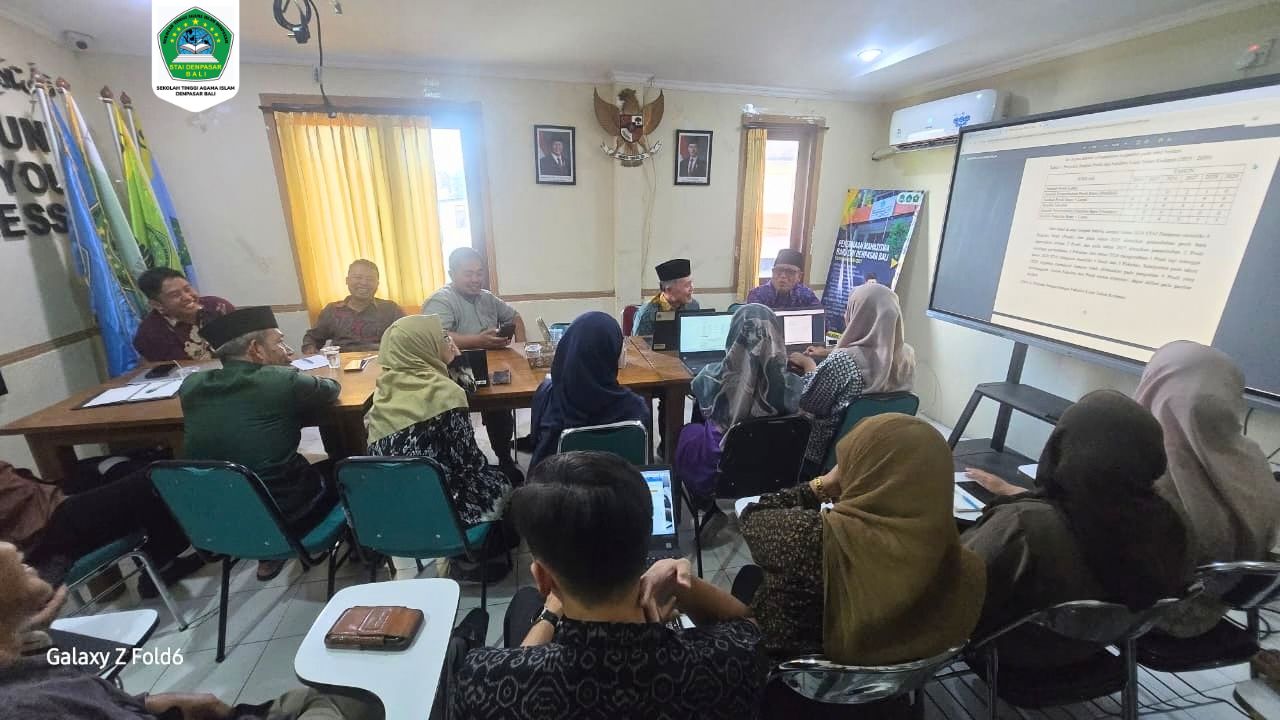
Denpasar, Bali — Sekolah Tinggi Agama Islam (STAI) Denpasar Bali held an academic and institutional management discussion on 16 September 2026 at STAI Denpasar Bali, focusing on academic data, institutional evaluation, and development strategies. The discussion formed part of the institution’s ongoing efforts to strengthen education quality through more accurate academic information, structured evaluation, strategic planning, and evidence-based decision-making.
The discussion highlighted the importance of placing reliable academic data at the center of institutional development. In higher education, data is not merely an administrative record but an important resource for understanding academic conditions, evaluating institutional performance, identifying areas for improvement, and establishing development priorities.
Academic Data as a Foundation for Education Quality
Academic data provides an important foundation for institutions when reviewing their current conditions and determining future directions. Information related to students, lecturers, study programs, academic administration, learning activities, and institutional performance can provide a broader picture of how academic processes are being managed.
For STAI Denpasar Bali, attention to academic data is particularly relevant to efforts to strengthen the quality and effectiveness of institutional management. Well-managed information can help ensure that academic planning is based on identifiable conditions rather than assumptions.
The discussion therefore placed data management within a broader educational context. Accurate information can support institutional leaders and relevant academic and administrative stakeholders in understanding existing conditions and considering appropriate steps for continuous improvement.
Strengthening Data Accuracy and Academic Governance
One of the important considerations in academic management is the quality of the data itself. Academic information needs to be accurate, consistent, updated, verifiable, and useful for decision-making. When these principles are maintained, data can serve a greater function than simply fulfilling administrative or reporting requirements.
Data accuracy is also closely connected with academic governance. Reliable information supports academic administration, institutional planning, monitoring and evaluation, quality assurance, reporting, and institutional accountability.
This perspective positions data management as a shared institutional responsibility rather than solely a technical or information-technology function. Academic units, administrative personnel, and other relevant stakeholders all have roles in ensuring that information used for institutional purposes remains reliable and properly managed.
Reviewing Academic and Institutional Conditions
The discussion also provided a context for reviewing academic and institutional conditions. By examining available information systematically, an institution can gain a clearer understanding of its current situation and identify areas that may require further attention.
Such a review can help distinguish existing strengths from areas requiring improvement while also providing a basis for identifying institutional priorities and opportunities for development. The approach encourages evaluation to be carried out constructively, with the objective of supporting institutional progress rather than simply identifying weaknesses.
In this context, academic data becomes part of an evaluation cycle. Information is collected and validated, analyzed to understand conditions, and then considered as a basis for determining appropriate institutional responses.
From Data Analysis to Institutional Development
The relationship between academic data and institutional development is reflected in the progression from data collection and validation to analysis, evaluation, strategic planning, implementation, monitoring, and improvement.
This process allows institutional development to be approached in a more structured and measurable manner. Reliable data can help an institution establish priorities, evaluate existing programs, monitor progress, and identify emerging challenges.
Depending on institutional needs and future priorities, strategic development may encompass areas such as academic quality, study program development, student services, lecturer development, academic administration, digital transformation, data governance, quality assurance, accreditation preparation, and institutional competitiveness. These areas require careful consideration based on the institution’s actual conditions and available evidence.
The discussion consequently positioned strategic planning as a process that should be connected with the academic realities reflected in institutional data.
Encouraging Evidence-Based Institutional Management
Another important dimension of the discussion was the role of evidence in institutional decision-making. Decisions supported by reliable academic information can provide a clearer basis for establishing measurable priorities and evaluating whether planned programs are producing the intended results.
Evidence-based institutional management can also contribute to more systematic resource planning, program evaluation, and monitoring. Rather than treating planning as a one-time activity, institutions can use data as part of an ongoing management cycle in which findings are reviewed and strategies are adjusted according to changing conditions.
For an Islamic higher-education institution, this approach also complements the broader responsibility of maintaining effective academic governance while pursuing educational and institutional development.
Strengthening a Culture of Continuous Improvement
Education quality is not achieved through a single program or meeting. It requires a continuous process of evaluation, implementation, monitoring, and improvement. The academic data discussion at STAI Denpasar Bali can therefore be understood within this broader quality-improvement framework.
Continuous improvement begins with understanding institutional conditions accurately. Data validation and analysis provide a foundation for evaluation, while strategic planning translates findings into possible development priorities. Implementation and monitoring then provide opportunities to assess progress and determine where further improvement may be necessary.
Such a cycle encourages institutional development to remain responsive, measurable, and connected to actual academic conditions.
Looking Ahead
The academic data and institutional development discussion held on 16 September 2026 reflects the importance of strengthening the relationship between reliable information, academic evaluation, strategic planning, and education quality improvement at STAI Denpasar Bali.
Moving forward, stronger academic data management can provide a more solid foundation for institutional planning and quality assurance. At the same time, collaboration among institutional leadership, academic personnel, administrative staff, study program representatives, and other relevant stakeholders remains important in translating reliable information into meaningful institutional development.
By continuing to strengthen data accuracy, evidence-based management, and systematic evaluation, STAI Denpasar Bali can build a more structured foundation for sustainable academic development and continuous improvement in education quality.