
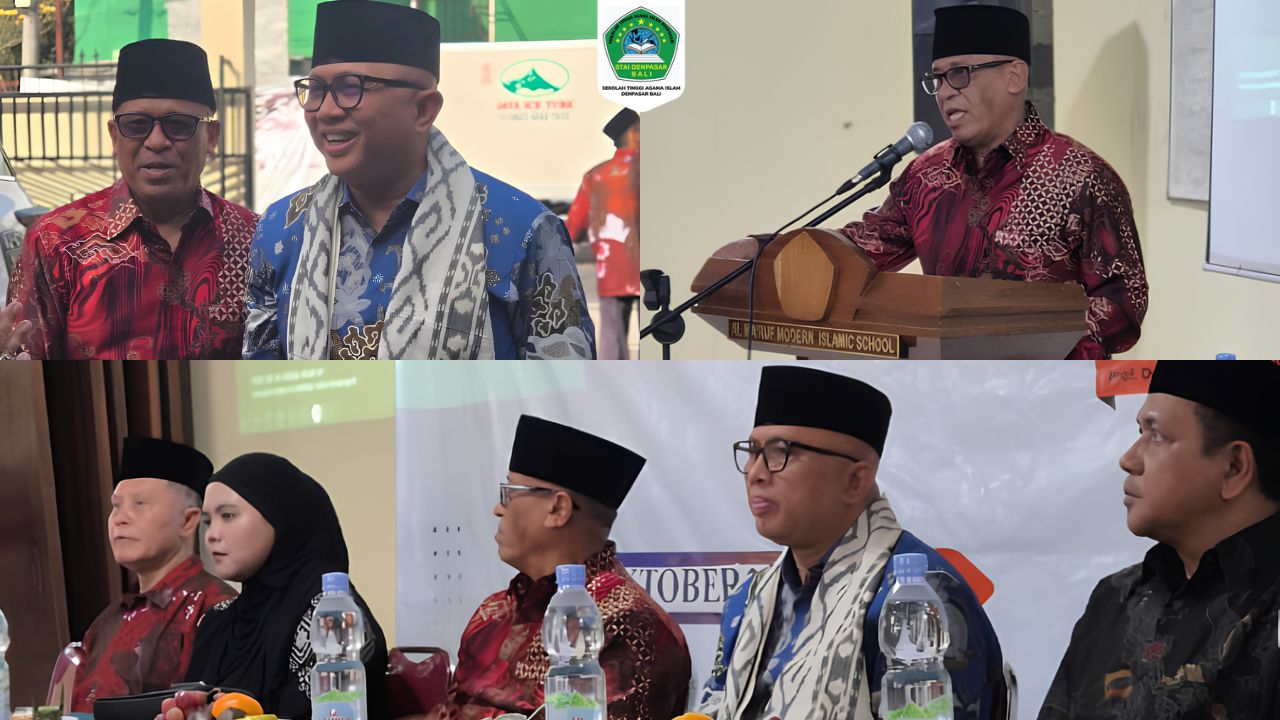
DENPASAR, Bali — Sekolah Tinggi Agama Islam (STAI) Denpasar Bali held a public lecture on October 23, 2026, at the STAI Denpasar Bali Hall, bringing together institutional leaders, government representatives, foundation leaders, academic figures, and religious leaders to discuss the institution’s future transformation. Carrying the theme “Transformasi STAI Denpasar Bali menuju Institut yang Unggul, Modern dan Moderat” or “Transforming STAI Denpasar Bali into an Excellent, Modern, and Moderate Institute,” the forum highlighted the strategic opportunities surrounding the institution’s development toward institute status.
The public lecture positioned institutional transformation not simply as a change in organizational status, but as an opportunity to strengthen academic quality, institutional capacity, governance, innovation, and social contribution. The discussion also underscored the importance of preparing an Islamic higher education institution that can remain relevant and responsive to changing educational and societal needs.
The principal government-level speaker was Prof. Dr. M. Arskal Salim GP., M.Ag., Secretary General of Islamic Education at the Ministry of Religious Affairs of the Republic of Indonesia. His participation provided a national Islamic higher education perspective to the discussion, particularly in relation to institutional development, academic quality, transformation, and the future direction of Islamic education.
The forum also brought together key figures from STAI Denpasar Bali and its supporting institutional ecosystem. Dr. H. Arjiman, M.Pd., Chair of STAI Denpasar Bali, represented the institution’s leadership and its vision for future development. Badi’atussholehah, M.M., Chair of the AlMaruf Modern Utama Islamic Education Foundation, represented the foundation’s role in supporting the institution’s development and sustainability.
Also participating was Dr. Jumari, M.Pd. S.P., M.Pd., Director of Education of the AlMaruf Modern Utama Foundation, whose role reflects the foundation’s broader involvement in educational development. Drs. H. Mahrusun, M.Pd., Chair of the Senate of STAI Denpasar Bali and Chair of the Indonesian Ulema Council (MUI) of Bali Province, contributed an academic and religious leadership perspective to the broader discussion of Islamic education in Bali.
The event also involved Dr. I Gusti Made Sunartha, S.Ag., M.M., Head of the Regional Office of the Ministry of Religious Affairs of Bali Province, representing the regional government perspective on the development of religious education and higher education within Bali.
A central issue emerging from the public lecture was the potential represented by STAI Denpasar Bali’s transformation into an institute. Such a transition can provide a strategic opportunity for broader academic development, stronger institutional governance, increased educational contributions, and greater competitiveness. However, these possibilities depend on sustained institutional development and should be understood as strategic directions rather than outcomes automatically guaranteed by a change in institutional status.
STAI Denpasar Bali also occupies a distinctive position within Indonesia’s higher education landscape because it is an Islamic higher education institution operating in Bali. This context creates opportunities for the institution to contribute to religious moderation, intercultural understanding, academic dialogue, social harmony, and inclusive education.
Rather than viewing cultural and religious diversity as a challenge, the institution’s position can provide a meaningful environment for developing graduates who combine academic competence with social responsibility. Islamic higher education in such a setting can contribute to constructive dialogue, peaceful coexistence, and an understanding of religious values within a diverse society.
The transformation agenda also points toward the importance of modernization and adaptability. Future-oriented higher education institutions need to respond to technological developments, changing educational needs, and evolving expectations from society. For STAI Denpasar Bali, this includes strengthening academic quality, developing human resources, improving institutional governance, embracing digital transformation, and maintaining a moderate and inclusive Islamic outlook.
The public lecture further demonstrated that institutional transformation requires collaboration across different stakeholder groups. Government representatives, foundation leadership, institutional management, academic governance, and religious leaders each have distinct roles in supporting the development of a sustainable higher education institution. A shared vision can provide an important foundation for ensuring that institutional transformation remains connected to academic quality and wider social contribution.
The vision of becoming an excellent, modern, moderate, adaptive, and competitive Islamic higher education institution therefore represents a broader development agenda for STAI Denpasar Bali. Excellence requires sustained attention to academic and institutional quality; modernization requires responsiveness to technological and educational developments; moderation requires a balanced and inclusive approach to Islamic values; adaptability requires the ability to respond to change; and competitiveness requires continuous institutional improvement.
The October 23 public lecture served as a forum for strengthening this shared vision. It emphasized that transformation is not merely about changing institutional status, but about strengthening the quality, relevance, governance, and contribution of the institution.
Looking ahead, STAI Denpasar Bali’s transformation agenda carries the aspiration of an institution that continues to grow, transform, and inspire on the Island of the Gods. Through continued collaboration, institutional strengthening, academic development, and commitment to moderate Islamic values, the transformation process can become part of a broader effort to develop an Islamic higher education institution that is relevant to Bali and responsive to the wider national higher education landscape.