
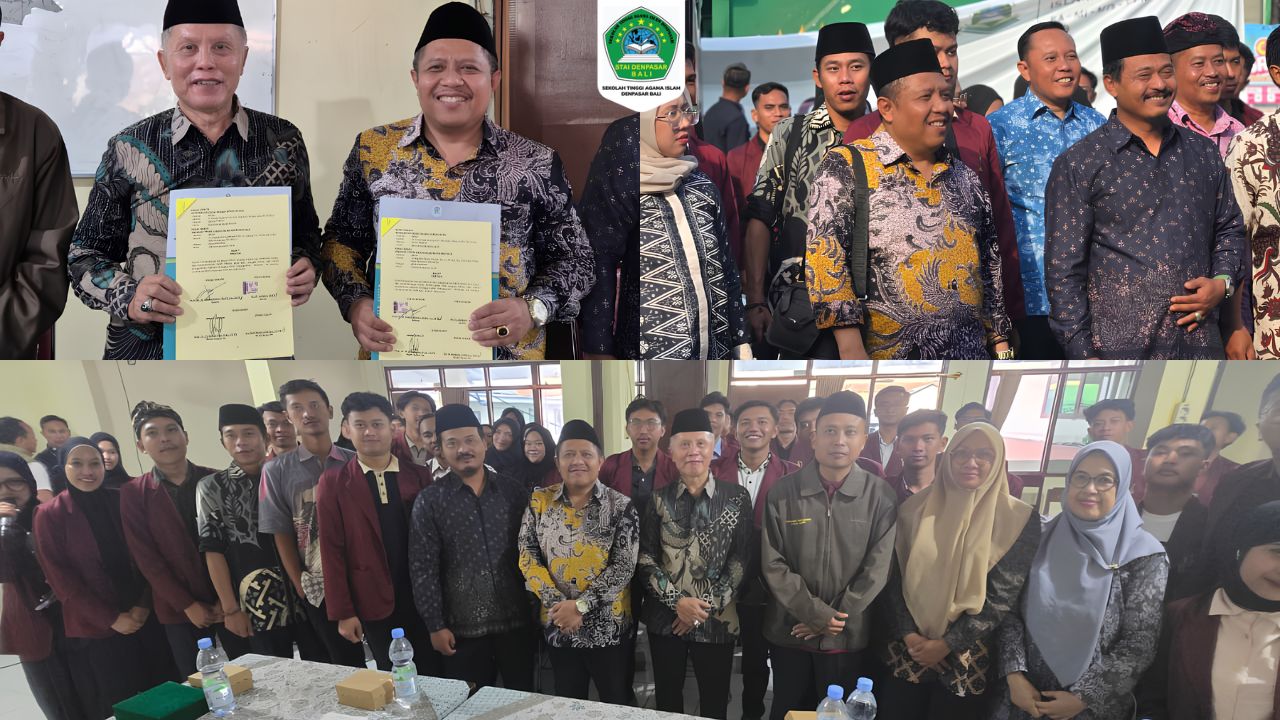
DENPASAR, BALI — October 21, 2026 — Sekolah Tinggi Agama Islam (STAI) Denpasar Bali welcomed a delegation from Universitas Islam Negeri (UIN) Sunan Kudus, Central Java, comprising 135 students and institutional representatives for an academic visit focused on cultural capacity building, creative-economy development, and student organization benchmarking. Held at the STAI Denpasar Bali Hall, the event carried the theme “Capacity Building from Culture to Creative Economy” and provided a platform for exchanging institutional experiences, strengthening student leadership, and exploring opportunities for future collaboration.
The delegation included students from economics-oriented faculties and study programs, alongside representatives of student organizations, including Unit Kegiatan Mahasiswa (UKM), Himpunan Mahasiswa (HIMA), Dewan Eksekutif Mahasiswa (DEMA), and Senat Mahasiswa (SEMA). Their participation highlighted the importance of connecting academic learning with organizational experience and developing competencies relevant to higher education, leadership, and the evolving creative economy.
STAI Denpasar Bali was represented by Dr. H. Arjiman, M.Pd., Chairperson of STAI Denpasar Bali; Dr. Sudarsono, S.Kom.I., M.Pd.I., Vice Chair III of STAI Denpasar Bali; and Dr. Jumari, S.P., M.Pd., Director of Education at the Al Ma’ruf Modern Foundation, Denpasar, Bali, who attended as a witness in the institutional context of the event. The visiting institution was represented by Prof. Dr. H. Abdurrohman Kasdi, Lc., M.Si., Rector of UIN Sunan Kudus, and Prof. Dr. H. Kisbiyanto, S.Ag., M.Pd., Vice Rector III of UIN Sunan Kudus.
Connecting Cultural Capacity Building with the Creative Economy
The theme “Capacity Building from Culture to Creative Economy” emphasized the relevance of cultural understanding, creativity, and innovation in preparing students to navigate social and economic opportunities. Cultural diversity provides an important context for learning, encouraging students to recognize different perspectives, appreciate local knowledge, and develop ideas that respond to the needs of their communities.
Within higher education, these competencies can contribute to the development of critical thinking, communication, collaboration, and problem-solving skills. Students who understand their cultural environments can also explore how local characteristics and creative ideas may inform economic initiatives and broader social development.
The participation of students from economics-oriented faculties and study programs added a relevant academic dimension to the visit. Combined with organizational experience, this engagement provided an opportunity to consider the relationship between knowledge, creativity, leadership, and the practical development of student competencies.
Recognizing Postgraduate Education in Bali’s Diverse Society
An important aspect of the visit was the appreciation expressed by Prof. Dr. H. Kisbiyanto, S.Ag., M.Pd., Vice Rector III of UIN Sunan Kudus, for the existence of STAI Denpasar Bali’s postgraduate program within Bali’s predominantly Hindu social and cultural environment.
This appreciation underscored the significance of expanding access to advanced Islamic education while maintaining respect for the cultural and religious diversity of the surrounding community. The development of postgraduate education in such an environment demonstrates the relevance of academic institutions in providing opportunities for further study and contributing to the development of knowledge.
The presence of the postgraduate program also offers a meaningful example of how Islamic higher education can develop within a pluralistic society. Educational institutions play an important role in promoting academic achievement, mutual respect, constructive dialogue, and responsible engagement among communities with different cultural and religious traditions.
Student Organization Benchmarking and Leadership Development
Student organization benchmarking formed a central component of the academic visit. Representatives of UKM, HIMA, DEMA, and SEMA from the participating institutions took part in organizational exchange and comparative learning, creating opportunities to examine different experiences in managing student organizations and supporting campus activities.
Particular attention was directed toward the roles of DEMA as a student executive organization, SEMA as a student senate or representative body, and HIMA as a student association generally organized around an academic program or discipline. UKM also represented an important part of the broader student activity and organizational landscape.
The exchange provided a context for discussing organizational governance, student representation, leadership, coordination, program planning, institutional communication, and student participation. Comparing organizational experiences can help students identify effective practices, understand differences in institutional arrangements, and develop ideas suited to their respective campus environments.
Such benchmarking is valuable because student organizations serve not only as platforms for extracurricular activities but also as spaces for learning accountability, teamwork, decision-making, and collaborative problem-solving. Engagement between student organizations from different institutions can broaden perspectives and encourage more responsive approaches to student representation and campus life.
Exploring Opportunities for Future Collaboration
Beyond cultural exchange and organizational learning, the visit also provided an opportunity for the two institutions to explore plans for future collaboration. The engagement reflected the potential value of continued communication between higher education institutions and their student communities.
By connecting academic perspectives, cultural understanding, and student organizational experience, the visit highlighted several areas in which institutional interaction can contribute to student development. These include leadership capacity building, comparative learning, academic exchange, and the exploration of creative-economy opportunities.
The academic visit of UIN Sunan Kudus to STAI Denpasar Bali therefore represented an opportunity to strengthen inter-institutional engagement while encouraging students to learn from different academic and cultural environments. Through continued communication and potential collaborative initiatives, both institutions have a foundation for exploring further opportunities that support higher education and student development.