
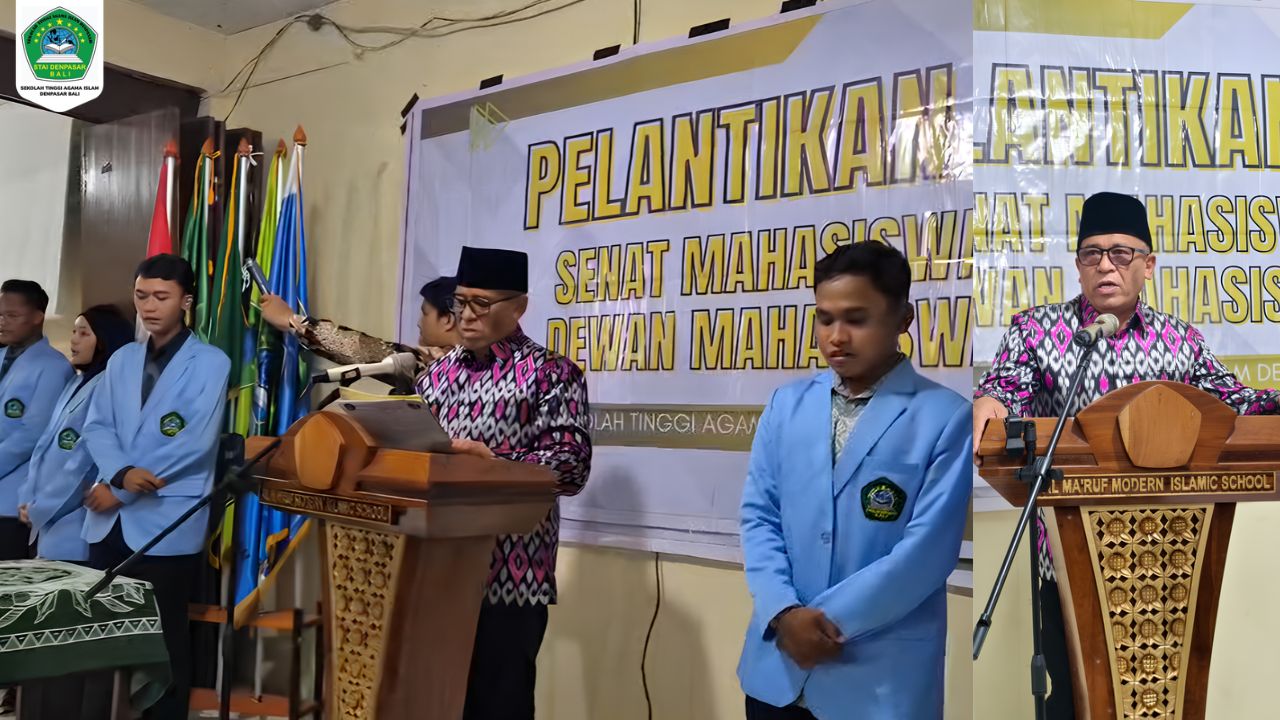
DENPASAR, Bali — Sekolah Tinggi Agama Islam (STAI) Denpasar Bali inaugurated its student organizations for the 2026 organizational period on October 24, 2026, at the STAI Denpasar Bali Hall. The event marked the transition of the Student Senate (SEMA), Student Executive Council (DEMA), and Study Program Student Associations (HIMAPRODI), representing a new stage in student leadership regeneration and organizational development within the campus community.
The inauguration was more than a formal transition of student organizations. It reflected the continuing process of developing student leadership, encouraging organizational participation, and maintaining continuity between one leadership period and the next. The transition from the 2025 organizations to the 2026 leadership provides an opportunity for students to build upon organizational experience while developing new approaches to campus engagement.
The event involved institutional leaders and study program representatives, including Dr. H. Arjiman, M.Pd., Chair of STAI Denpasar Bali, and Dr. Sudarsono, M.Pd., Vice Chair III for Student Affairs and Cooperation. Their institutional roles place student affairs and organizational development within the broader framework of student development and campus life.
The event also involved Mukhtar Saifudin, Secretary of the Bachelor of Islamic Education (S1 PAI) Study Program; Adisti Nur Inayah, Secretary of the Bachelor of Islamic Education Management (S1 MPI) Study Program; Harisatun Niswa, Secretary of the Bachelor of Sharia Economics (S1 ES) Study Program; and Fatma Hidayah, Secretary of the Bachelor of Islamic Communication and Broadcasting (S1 KPI) Study Program.
Leadership Regeneration through SEMA and DEMA
The transition within SEMA represented one of the key elements of the 2026 organizational regeneration. The outgoing 2025 SEMA leadership consisted of Durrotun Nasihah and Lailatur Rohmah, while Ahmad Fadlilul became part of the incoming 2026 leadership.
The transition in the Student Executive Council (DEMA) similarly marked the continuation of student executive leadership. Nadia Rizky represented the outgoing 2025 DEMA leadership, while Naufal Roofi represented the incoming 2026 leadership.
These transitions demonstrate how student organizations can provide a continuing environment for leadership development. Through organizational succession, students have opportunities to learn responsibility, teamwork, communication, decision-making, and organizational management while ensuring that student activities remain connected across different leadership periods.
SEMA, as a student representative organization, can provide a forum for student representation, aspirations, and organizational oversight within the campus environment. Meanwhile, DEMA serves as a student executive organization that can facilitate student activities, programs, and broader student engagement. Their respective roles contribute to a student community in which participation and organizational responsibility extend beyond classroom learning.
HIMAPRODI Strengthens Study Program-Based Student Engagement
The inauguration also included the transition of Study Program Student Associations, or HIMAPRODI, within S1 PAI, S1 Sharia Economics (ES), and S1 Islamic Education Management (MPI). The transition of these organizations represents the continuation of student engagement within individual academic programs.
HIMAPRODI provides a study-program-based organizational environment in which students can potentially develop academic engagement, organizational skills, collaboration, professional interests, and communication abilities. Its connection to specific academic programs also creates opportunities for students to connect organizational activities with their broader educational experience.
A particularly significant development in the 2026 organizational period was the establishment of HIMAPRODI for the S1 Islamic Communication and Broadcasting (KPI) Study Program for the first time. The formation of HIMAPRODI S1 KPI expands the student organizational ecosystem at STAI Denpasar Bali and establishes a new platform for students within the program to participate in organizational activities.
As a study-program-based organization, HIMAPRODI S1 KPI has the potential to provide opportunities for students to develop communication and leadership skills, strengthen academic engagement, explore creativity and media-related interests, build collaborative experience, and prepare for professional environments. These represent potential areas of student development rather than specific programs already implemented by the organization.
Beyond the Classroom: Developing Student Leadership
Student organizations play an important complementary role in higher education by creating spaces where students can develop competencies that extend beyond formal classroom instruction. Leadership, teamwork, communication, responsibility, critical thinking, organizational management, and collaboration can be developed through meaningful participation in student activities.
For STAI Denpasar Bali, the transition to the 2026 student organizations represents an opportunity to strengthen this aspect of campus life. The continuity of SEMA, DEMA, and existing HIMAPRODI, together with the establishment of HIMAPRODI S1 KPI, creates a broader organizational environment for student participation and academic-community engagement.
The transition from the 2025 to 2026 leadership is therefore not simply a change in personnel. It is part of an ongoing process of student leadership regeneration in which organizational experience can be transferred, new students can assume responsibility, and the campus community can continue developing its culture of participation.
The inauguration of the 2026 student organizations marks a new chapter for student leadership at STAI Denpasar Bali. As the new organizational period begins, SEMA, DEMA, and HIMAPRODI are positioned to contribute to a more active and collaborative student community, while the establishment of HIMAPRODI S1 KPI adds a new dimension to the institution’s growing student organizational landscape.
Ultimately, student organization regeneration is closely connected to the development of responsible and capable future leaders. Through continuity, participation, collaboration, and organizational learning, the 2026 student organizations can become an important part of the broader educational experience at STAI Denpasar Bali.