
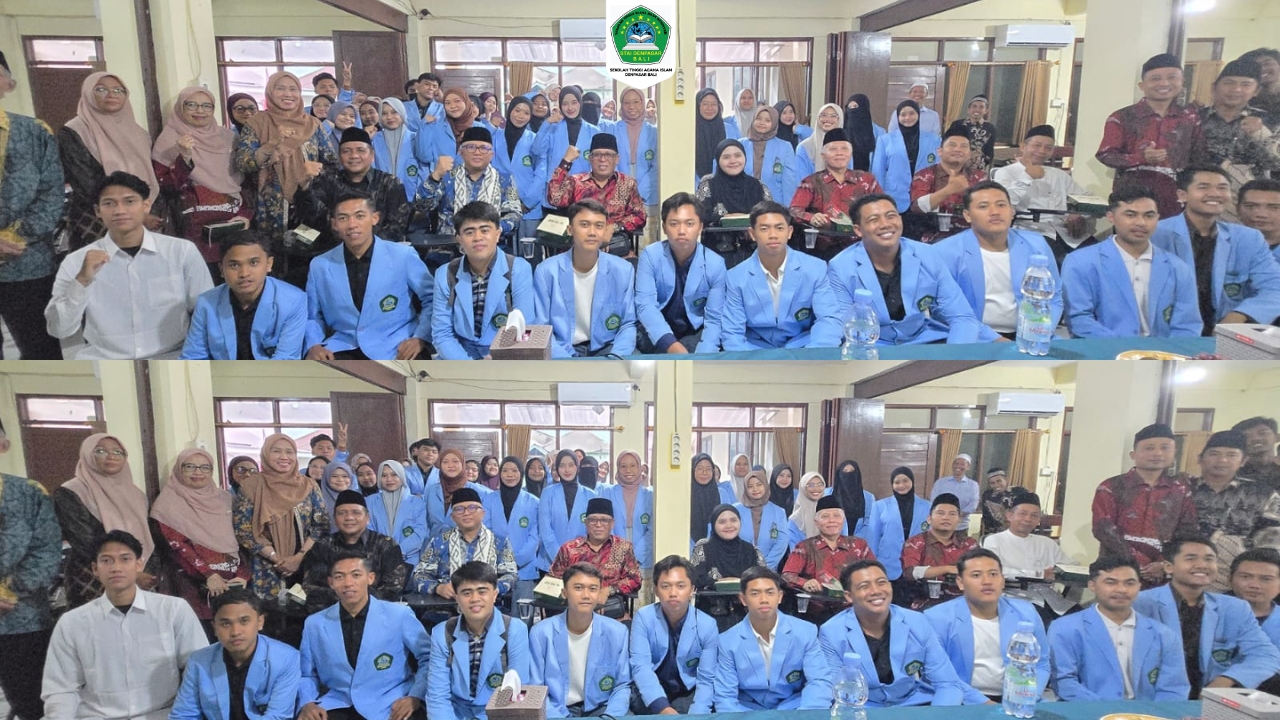
DENPASAR, Bali – The future of Islamic education in the digital era became the central focus of an academic discussion at Sekolah Tinggi Agama Islam (STAI) Denpasar Bali on October 23, 2026. During his official visit to the institution, Prof. Dr. M. Arskal Salim GP, M.Ag., Secretary of the Directorate General of Islamic Education at the Ministry of Religious Affairs of the Republic of Indonesia, addressed the theme “Revitalizing Islamic Education in the Digital Era: Addressing Global Challenges and the Identity Crisis of Generation Z.” The discussion provided an intellectual platform for examining how Islamic higher education can respond to technological disruption, globalization, and the evolving challenges of younger generations while preserving Islamic intellectual and moral foundations.
The event, held at the STAI Denpasar Bali Hall, brought together the institution’s leadership, academic community, lecturers, educational and administrative staff, and students from five study programs: Bachelor of Islamic Education (S1 PAI), Bachelor of Islamic Education Management (S1 MPI), Bachelor of Sharia Economics (S1 ES), Bachelor of Islamic Communication and Broadcasting (S1 KPI), and Master of Islamic Education (S2 PAI). Their participation reflected the relevance of digital transformation across academic disciplines and institutional responsibilities, extending beyond teaching and learning to include educational governance, research, communication, and administrative services.
Understanding the Challenges of the Digital Generation
One of the important concerns addressed in the discussion was the changing relationship between younger generations and digital information. Generation Z and Generation Alpha have grown up in an environment characterized by extensive internet access, rapid information exchange, and increasingly sophisticated digital technologies. Although this environment creates valuable opportunities for learning, it also presents challenges involving misinformation, disinformation, digital ethics, and the reliability of online religious content.
A phenomenon sometimes described as “Google Ustadz” illustrates the tendency to obtain religious guidance through online searches without sufficiently verifying the credibility of sources. This situation highlights the importance of strengthening religious literacy, digital literacy, and critical thinking. Access to information alone does not guarantee sound religious understanding or responsible interpretation.
These challenges also raise questions about curriculum relevance and the traditional separation between religious sciences and modern scientific disciplines. Islamic educational institutions therefore need to develop learning approaches that respond to contemporary developments without compromising established scholarly traditions, ethical responsibilities, and fundamental Islamic values.
Tajdid, Islah, and Ihya’: Foundations for Educational Renewal
The revitalization of Islamic education can be understood through three interconnected Islamic intellectual concepts: Tajdid, Islah, and Ihya’.
Tajdid refers to renewal, particularly the development of educational methods, curricula, research approaches, and learning strategies in response to contemporary needs. Islah emphasizes reform and improvement, including the strengthening of academic integrity, institutional governance, educational quality, and professional responsibility. Meanwhile, Ihya’ represents revival, particularly the revitalization of Islamic intellectual traditions, scholarly inquiry, research culture, and the spirit of knowledge that contributed to the development of Islamic civilization.
Together, these principles offer a framework for educational transformation that respects the intellectual heritage of Islam while encouraging innovation and constructive engagement with modern developments.
Integrating Islamic Knowledge and Modern Science
Another central dimension of educational revitalization concerns the epistemological foundation of knowledge. Within Islamic education, Tawhid, or the oneness of God, provides a fundamental philosophical orientation for understanding knowledge, human responsibility, and the relationship between scientific inquiry and ethical values. This perspective encourages academic development to remain connected with spiritual awareness and the objectives of Maqasid al-Shariah.
The discussion of knowledge integration can also be understood through the intellectual contributions of Ismail Raji al-Faruqi and Syed Muhammad Naquib al-Attas, particularly their respective approaches to the Islamization of Knowledge. Amin Abdullah’s integration-interconnection framework offers another perspective by encouraging dialogue between religious sciences, natural sciences, social sciences, humanities, and contemporary technological disciplines.
Although these intellectual approaches have different philosophical emphases, they share a broader concern with overcoming fragmented approaches to knowledge and strengthening meaningful relationships between academic disciplines.
This perspective is particularly relevant to Islamic higher education, where scientific advancement should be accompanied by ethical reflection, intellectual responsibility, and an understanding of the broader purposes of human knowledge.
Developing a Holistic and Technology-Responsive Curriculum
The integration of Islamic knowledge and modern science also creates opportunities for interdisciplinary learning and research. Several illustrative connections demonstrate how traditional Islamic disciplines can engage with contemporary knowledge and technology.
Fiqh, for example, can be examined alongside blockchain technology to explore Islamic legal and ethical perspectives on digital transactions. Tafsir can engage with artificial intelligence as a supporting analytical tool for research and textual studies, while maintaining the authority of qualified scholars and established interpretative methodologies. Hadith studies can contribute to the development of critical approaches to source verification and digital hoax detection.
Similarly, Tasawwuf can enter into dialogue with psychology in examining spiritual development and human well-being. Islamic history can also benefit from digital humanities through technological methods for researching, preserving, analyzing, and disseminating historical knowledge.
These interdisciplinary possibilities demonstrate that technology should complement, rather than replace, scholarly expertise and established academic methodologies. They also offer directions for developing a more holistic Islamic educational curriculum responsive to contemporary intellectual challenges.
Transforming Educators and Building an Islamic Digital Ecosystem
Digital transformation also requires a broader understanding of the responsibilities of lecturers and educators. Beyond their conventional instructional roles, educators need to develop complementary competencies as Ulama (religious scholars), scientists and researchers, digital creators, and character mentors.
This transformation involves familiarity with Learning Management Systems (LMS), responsible artificial intelligence utilization, digital research methodologies, social media-based Islamic communication, online academic collaboration, and the development of educational content. However, digital competence should not be measured merely by the ability to operate technological platforms. It must also involve ethical judgment, academic integrity, pedagogical innovation, and the ability to guide students in developing intellectual maturity.
At the institutional level, developing an Islamic digital ecosystem requires collaboration through a Four-Helix framework involving universities, Islamic boarding schools (pesantren), industry, and government institutions. Cooperation among these stakeholders can create opportunities for developing Islamic educational content, digital libraries, anti-hoax journalism, halal economic innovation, research collaboration, and responsible digital communication.
Such collaboration provides a broader foundation for ensuring that technological developments contribute to educational advancement and the constructive dissemination of Islamic knowledge.
Students as Agents of Islamic Civilization
Students also occupy an essential position in the future of Islamic education. The concept of Ulul Albab provides an important intellectual and spiritual ideal, integrating Dhikr (spiritual remembrance and reflection), Fikr (critical thinking and intellectual inquiry), and Amal (meaningful action and contribution).
Within this framework, students are encouraged to develop beyond academic achievement and become responsible contributors to society. Their potential roles include digital preachers who disseminate reliable Islamic knowledge, innovators in the halal economy, social activists, young researchers, and cultural diplomats who promote intercultural understanding.
These aspirations are relevant across the academic disciplines at STAI Denpasar Bali. Islamic Education students can explore the responsible integration of Islamic pedagogy and artificial intelligence; Islamic Education Management students can engage with digital educational governance; Sharia Economics students can examine financial technology and halal economic innovation; Islamic Communication and Broadcasting students can contribute to ethical digital communication; and postgraduate Islamic Education students can strengthen interdisciplinary research and educational epistemology.
Achieving these aspirations requires a shared commitment from institutional leadership, lecturers, educational staff, students, families, government, and society. Institutional leaders must support infrastructure and an environment conducive to innovation, while educators provide academic and ethical guidance. Students are expected to develop critical thinking and responsible digital behavior, and families play an important role in strengthening character and digital responsibility.
For STAI Denpasar Bali, the discussion provided an important opportunity to reflect on the future direction of Islamic higher education amid rapid technological and social change. Revitalization requires more than adopting new technologies; it demands epistemological renewal, curriculum innovation, stronger academic competencies, ethical responsibility, and the preservation of Islamic intellectual identity.
Ultimately, the development of Islamic education in the digital era depends on the ability to connect faith, knowledge, technology, and meaningful action. Through continuous academic development and collaboration, STAI Denpasar Bali has an important role in preparing a generation of Muslim intellectuals who are knowledgeable, ethically grounded, digitally competent, and capable of contributing to society and the advancement of Islamic civilization.