
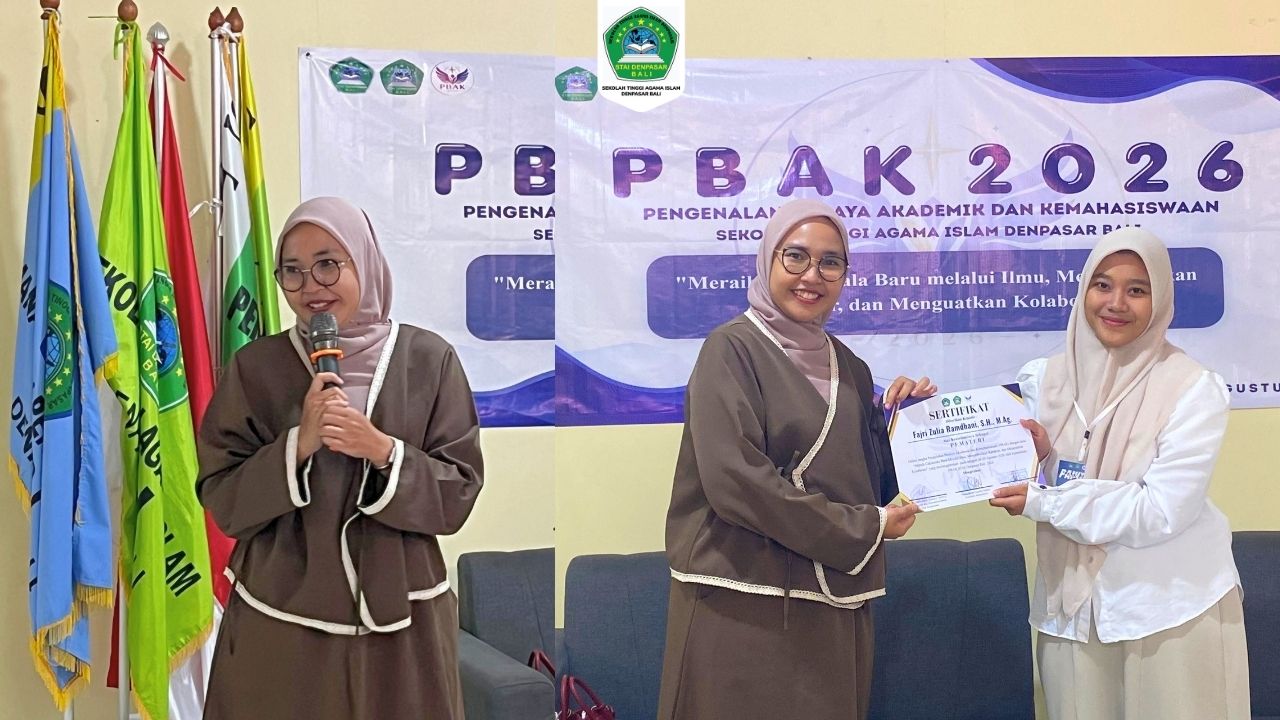
STAI Denpasar Bali – continued its 2026 New Student Academic and Cultural Orientation Program, known as Pengenalan Budaya Akademik (PBAK), through a Character Building session designed to strengthen resilience, perseverance, self-confidence, adaptability, and a constructive mindset among new students.
The session was delivered by Fajri Zulia Ramdhani, S.H., M.Ag., Vice Director of the Graduate Program at STAI Denpasar Bali, and moderated by Najwa Surya Ram Dhiana. As an integral part of the orientation program, the session introduced students to the importance of character development during their transition into higher education and encouraged them to prepare themselves not only for academic demands but also for personal, social, and future professional challenges.
The discussion emphasized that the journey toward personal growth and meaningful achievement is rarely entirely smooth. Achievements that are visible to others are often preceded by repeated attempts, mistakes, setbacks, reflection, and continuous learning. For this reason, failure should not automatically be understood as the end of a journey or as a reason for individuals to underestimate their own abilities.
Instead, the session highlighted the importance of viewing setbacks as opportunities to reassess one’s efforts, identify areas that require improvement, and prepare for the next attempt with greater awareness. Academic and personal development often involve numerous stages, and progress may emerge gradually through experiences that are not always immediately successful.
Students were therefore encouraged not to allow a single unsuccessful attempt to determine their future direction. An initial failure can provide valuable experience by revealing weaknesses, identifying gaps in preparation, and helping individuals understand what needs to be developed further. When approached with reflection and a willingness to learn, unsuccessful experiences can become part of a broader process of growth.
The Character Building session also underscored that persistence should not simply mean repeating the same effort without change. Continuing to try is important, but meaningful persistence must be accompanied by evaluation, reflection, and improvement. After encountering difficulties or setbacks, individuals need to examine their previous approaches and consider what can be adjusted.
Every new attempt can therefore become more focused and purposeful when it is informed by lessons from previous experiences. Reflection allows students to recognize areas for improvement, while adaptation and improvisation can help them respond more effectively to changing circumstances. In this sense, resilience is not merely the ability to endure challenges, but also the capacity to learn, adapt, and continue developing.
Another central theme of the session was the importance of trusting the process. Meaningful academic and personal development requires time, consistency, discipline, and patience. Even achievements that may appear immediate often involve preparation and unseen processes that precede the final result.
Students were encouraged to appreciate every stage of their development rather than focusing exclusively on immediate outcomes. The process of learning, improving, and gradually building competence is itself an important part of achievement. Patience does not mean remaining passive, but maintaining commitment while continuing to take purposeful steps toward meaningful goals.
The discussion also addressed the importance of building a strong and realistic foundation when pursuing personal aspirations. Students may have ambitions to continue their education, participate in academic exchange programs, develop professional expertise, or pursue other meaningful opportunities. However, aspirations require more than intention alone.
Dreams need to be supported by preparation, competence, effort, persistence, and a willingness to seek or create opportunities. The session reminded students that circumstances and access to opportunities may differ from one individual to another. Nevertheless, students can continue strengthening their readiness by developing knowledge, skills, experience, and personal capacity.
By taking concrete steps and maintaining continuous self-development, aspirations can gradually move beyond wishes and become structured goals supported by preparation and purposeful action. This approach also encourages students to recognize that progress is often built through small but consistent efforts.
The session further explored experiences of insecurity, self-doubt, inferiority, and discomfort that may arise when individuals face unfamiliar situations or compare themselves with others. Such experiences can be part of the process of adaptation and self-awareness and should not automatically be interpreted as evidence of failure or inability.
Students were encouraged to understand their own strengths and areas for development without allowing comparisons with others to undermine their motivation. University life introduces students to new academic environments, diverse abilities, different backgrounds, and varying levels of experience. Learning to respond to these circumstances with self-awareness can support the development of confidence and emotional maturity.
Discomfort, in this context, can become part of personal growth. Entering unfamiliar environments, taking on new responsibilities, participating in discussions, or pursuing challenging opportunities may require students to move beyond their usual routines. These experiences can contribute to adaptability and help individuals discover capacities that may not emerge without challenge.
The Character Building session also emphasized that every individual follows a different timeline of progress and achievement. The fact that a goal has not yet been achieved does not mean that it will never be achieved. Progress may occur at different stages of life and may require varying amounts of preparation, experience, and persistence.
Students were therefore encouraged to maintain direction and continue learning without becoming discouraged by comparisons with the achievements or timelines of others. A person’s academic, professional, and personal journey is shaped by different circumstances and experiences. Maintaining consistency and a commitment to self-improvement can be more constructive than measuring one’s progress solely against external expectations.
The broader message of the session was that character is not formed only through achievement. It is also developed through the ability to respond to difficulties, learn from experience, evaluate previous efforts, make improvements, and continue moving forward despite uncertainty.
Failure, therefore, can become material for evaluation rather than a reason to give up. Students were encouraged to give themselves opportunities to continue trying, while ensuring that every subsequent effort is supported by greater understanding and better preparation. Persistence, continuous learning, thoughtful evaluation, and the willingness to improve can help individuals move closer to their long-term goals, even when progress is gradual.
Within the broader educational context of STAI Denpasar Bali, the Character Building session reflects the importance of developing students holistically. Higher education is not only a process of acquiring academic knowledge and professional expertise. It is also a process of developing maturity, responsibility, discipline, integrity, resilience, adaptability, and strong personal character.
These qualities are increasingly important as students navigate academic assignments, organizational responsibilities, interpersonal relationships, social dynamics, and future professional demands. Academic competence provides an important foundation, but the ability to manage challenges, adapt to change, and maintain responsibility can significantly support students throughout their educational and professional journeys.
STAI Denpasar Bali seeks to support the development of students who are not only academically capable but also prepared to respond constructively to challenges. Through educational activities such as the 2026 PBAK program, new students are introduced to perspectives that can help them build a strong foundation for continuous personal and professional development.
The Character Building session provided an opportunity for students to reflect on how they approach challenges, setbacks, aspirations, and personal growth. The discussion emphasized that meaningful development requires both courage and patience: the courage to take another step after an unsuccessful attempt and the patience to recognize that significant progress may require time.
As new students begin their academic journey at STAI Denpasar Bali, the values highlighted during the session are expected to remain relevant throughout their university experience. Challenges and setbacks can become opportunities for learning when students are willing to reflect on their experiences, improve their strategies, and continue developing themselves.
The central message of the session can be understood as an encouragement not to stop after one failure, but to continue trying, learn from experience, make meaningful improvements, and trust that progress develops through time and sustained effort.
Character development, like academic development, is a continuous process. By maintaining resilience, strengthening self-awareness, learning from every experience, and remaining committed to meaningful goals, new students of STAI Denpasar Bali are expected to grow into academically capable, emotionally mature, adaptable, responsible, and resilient individuals who are prepared to face future challenges and continue moving forward throughout their personal and professional journeys.