
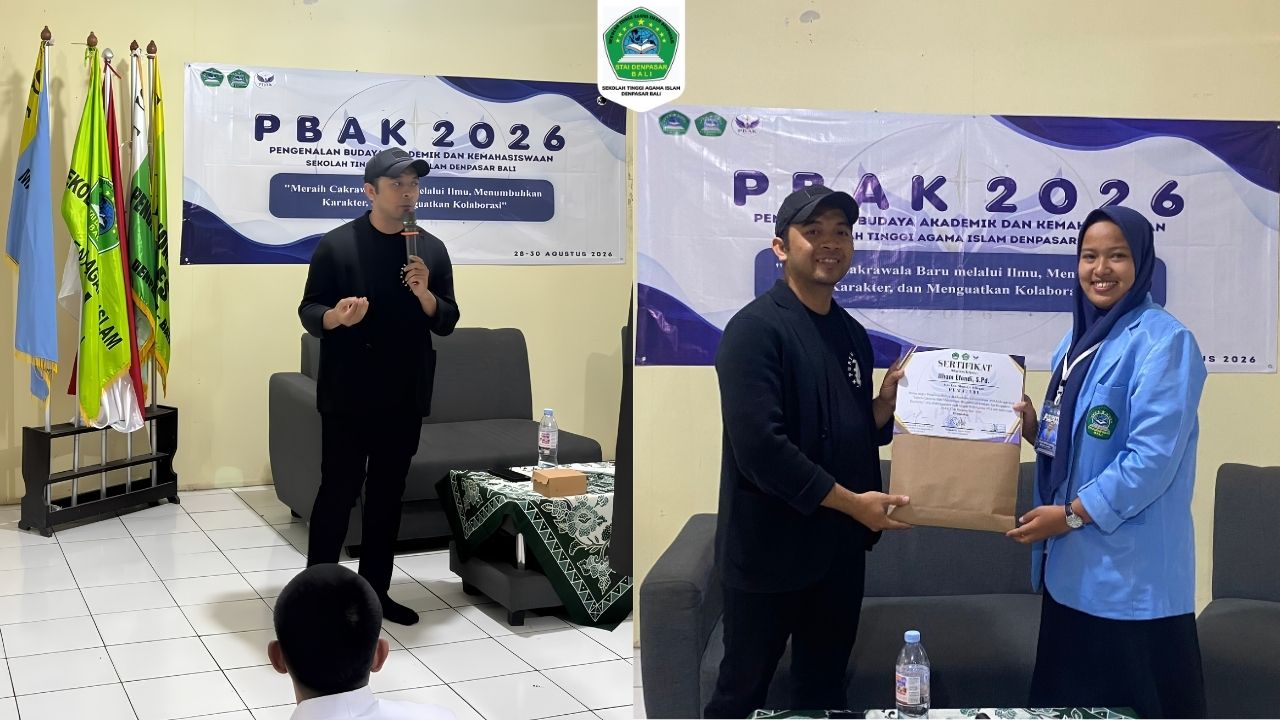
STAI Denpasar Bali continued its 2026 New Student Academic and Cultural Orientation Program, known as Pengenalan Budaya Akademik (PBAK), through a session on National Development and Religious Moderation. The activity was designed to provide new students with a broader understanding of national values, citizenship, diversity, religious moderation, peaceful coexistence, and responsible participation in society.
The session was delivered by Ilham Efendi, S.Pd., an author and alumnus of STAI Denpasar Bali, and was moderated by Durrotun Nasihah. Through the discussion, participants were encouraged to develop a balanced perspective as Indonesian citizens, members of the academic community, and future professionals who are expected to contribute positively to the development of society.
A central focus of the session was the importance of strengthening students’ national insight and awareness of the fundamental principles that support Indonesia’s unity. The discussion highlighted the four pillars of national consensus: Pancasila, the 1945 Constitution of the Republic of Indonesia, the Unitary State of the Republic of Indonesia (Negara Kesatuan Republik Indonesia/NKRI), and Bhinneka Tunggal Ika, or Unity in Diversity.
These principles were presented as an essential foundation for strengthening citizenship awareness, preserving national unity, respecting differences, and promoting a peaceful and inclusive society. For university students, an understanding of these national foundations is particularly important because higher education is expected to develop not only academic competence but also responsible citizenship. Students were encouraged to recognize their role as young intellectuals who can contribute ideas, knowledge, and constructive participation to Indonesia’s future development.
The session also provided an important discussion on the concept of religious moderation. The material emphasized that religious moderation does not mean changing, reducing, or compromising the essential teachings and principles of a religion. Rather, it refers to the development of a balanced perspective, attitude, and religious practice that remains faithful to religious values while respecting human dignity and promoting the common good.
Four important indicators of religious moderation were highlighted: national commitment, tolerance, anti-violence, and acceptance of local traditions. These principles provide a framework for individuals to practice their faith responsibly while respecting the rights, beliefs, cultural traditions, and dignity of others. Participants were encouraged to understand that strong religious commitment and respect for diversity can develop together as complementary values within Indonesia’s pluralistic society.
The discussion further explored the relationship between nationalism and religious values. Religious teachings were presented as a source of moral and ethical inspiration that can contribute to the development of a just, peaceful, prosperous, and harmonious nation. In this context, religion should encourage constructive contributions to society and strengthen ethical responsibility rather than becoming a source of division or conflict.
The principle of equal citizenship was also emphasized. Regardless of differences in religious or belief backgrounds, citizens share equal rights and responsibilities before the law and the state. This understanding is important for strengthening social cohesion and ensuring that diversity becomes a source of mutual learning and cooperation.
Closely connected to this discussion was the concept of the middle path, or wasathiyah. Students were encouraged to develop balanced and contextual perspectives in religious and social life. The session underscored the importance of avoiding extreme positions, including rigid attitudes that reject dialogue and coexistence, as well as interpretations that disregard essential religious principles. A balanced approach requires sound understanding, critical reflection, wisdom, and the ability to respond responsibly to changing social circumstances.
The challenges of the modern digital environment also received significant attention. Digital technology provides students with broad access to information, academic resources, communication networks, and public discourse. However, the rapid circulation of information also requires strong digital literacy and responsible participation.
Students were encouraged to develop the habit of verifying information before sharing it and to avoid contributing to the spread of misinformation and hoaxes. The discussion also highlighted the importance of rejecting hate speech and discriminatory narratives, while understanding the potential risks of identity-based conflict in digital spaces. As members of an increasingly connected generation, students are expected to become critical and responsible users of technology who can use digital platforms to promote knowledge, tolerance, peace, and constructive public dialogue.
Digital literacy was also connected to efforts to prevent the spread of radical and extremist narratives. Participants were encouraged to develop critical thinking skills, strengthen their understanding through credible sources of knowledge, and engage with information responsibly. The session emphasized education, awareness, dialogue, and sound knowledge as important foundations for preventing the development of destructive ideologies without stigmatizing any particular religious, ethnic, cultural, or social group.
In discussing the historical development of Indonesia, the session also highlighted the importance of understanding the contributions of religious leaders and religious communities to the nation’s struggle for independence, nation-building, and the development of national identity. This historical perspective demonstrates that religious values and national commitment can strengthen one another.
The concept of religious nationalism was therefore presented as an understanding in which religious conviction and commitment to the nation can work together in supporting unity, peace, and the common good. Students were encouraged to view national consensus not merely as a constitutional or political framework, but also as a shared foundation that enables people of different backgrounds to live, cooperate, and develop together as citizens of Indonesia.
Another important aspect of the session concerned conflict management and peacebuilding. In a diverse society, differences of opinion, belief, culture, and social background may create challenges that require maturity and constructive responses. The discussion emphasized the importance of interfaith dialogue, open and respectful communication, early identification of potential conflicts, mediation, and constructive problem-solving.
Dialogue was presented as an important instrument for building mutual understanding and preventing misunderstandings from developing into larger social conflicts. Students were encouraged to develop communication skills that allow them to listen, understand different perspectives, and seek peaceful solutions. Through these approaches, young people can become agents of peace who contribute to cooperation, reconciliation, and social harmony.
The material also addressed the roots and characteristics of extremist thinking. Radicalism and extremism can develop through multiple and interconnected factors, including social, ideological, educational, economic, political, and digital influences. For this reason, prevention requires a comprehensive approach that strengthens education, critical thinking, sound religious understanding, constructive dialogue, and access to credible sources of knowledge.
Rather than responding through stigma or exclusion, the discussion emphasized the importance of developing awareness and resilience against destructive narratives. Students were encouraged to examine information critically, avoid simplistic judgments, and strengthen their ability to engage in thoughtful and evidence-based discussion.
The session also highlighted the importance of revitalizing local wisdom as a means of strengthening social cohesion. Cultural traditions and local values can serve as important social bonds that encourage mutual respect, cooperation, solidarity, and peaceful coexistence. Within the multicultural environment of Bali, this perspective is particularly relevant to the educational and social experiences of students at STAI Denpasar Bali.
Students are expected to maintain their religious identity while also understanding, respecting, and engaging positively with the communities and cultural diversity around them. Respect for local wisdom does not require the abandonment of religious principles. Instead, students can develop a thoughtful and responsible approach to social interaction by recognizing the importance of mutual understanding and peaceful coexistence within a pluralistic society.
The National Development and Religious Moderation session reflects the broader educational mission of STAI Denpasar Bali to prepare students who are academically capable, nationally committed, religiously mature, tolerant, responsible, digitally literate, and socially aware. Higher education is not limited to the acquisition of academic knowledge but also involves the formation of character, citizenship, ethical awareness, and the ability to respond constructively to contemporary challenges.
For students studying and developing within Bali’s diverse social environment, these values provide an important foundation for meaningful interaction with people from different cultural, religious, and social backgrounds. STAI Denpasar Bali continues to emphasize the importance of maintaining Islamic values while fostering tolerance, mutual respect, peaceful coexistence, and positive contributions to society.
The session was formally concluded with a closing statement and an award presentation delivered by Nurin Nadia Izzatul Lillah, Vice President of the Student Executive Body. The closing moment reflected appreciation for the speaker’s contribution and the educational value of the discussion, which provided new students with important perspectives on national awareness, diversity, religious moderation, and social responsibility.
As part of the broader 2026 PBAK program, the session is expected to provide a meaningful foundation for new students throughout their academic journey. The values discussed are relevant not only to university life but also to students’ future roles as citizens, professionals, community members, and leaders.
Through a strengthened commitment to national unity, a balanced and thoughtful understanding of religion, responsible digital participation, and an active role in promoting peace, new students of STAI Denpasar Bali are expected to develop into responsible citizens and future leaders who can contribute to a united, inclusive, peaceful, and prosperous Indonesia.